Parent Information, The Montessori Method

Freedom & Limits: from birth to 18 years old


In this blog post you will find my notes from the 2024 Nienhuis Retreat and the lectures from some of Europe’s best AMI Trainers from 0-18. They are incredible women with decades of experience who have trained hundreds of teachers around the world. They are Patricia Wallner, Madlena Ulrich, Carla Foster, and Jenny Marie Hรถglund. ๐Ÿ’› ๐Ÿ’› ๐Ÿ’›

PDF Versions | 0-3 | 3-6 | 6-12 | 12-18

freedom & limits in the first 3 years of life

notes from Patricia Wallner’s lecture

  • The ages 0-6 and 12-18 are stages of creation – during which freedom and limits are necessary for the formation of the individual.
  • Freedom is something everyone wants – economic freedom, professional freedom, spiritual freedomโ€ฆ. But we cannot do anything we want without consequences. The limits are those that we accept within our community (family, school, neighborhood…world) and learn to live within.
  • In Montessori, as it should be everywhere, the child has the freedom to move, to stay on a task as long as they want, to order one’s own actions, and to develop their will.
  • Of course, as the child’s freedom expands, as do their responsibilities and need for self-discipline, but fundamentally their freedom is of that of the individual to have unlimited possibilities for growth and improvement. This freedom should be the basis of human society.

The only true freedom for an individual is to have opportunity to act independently.โ€

– Dr. Maria Montessori, Education and Peace, chapter 7

  • Adolescents have the freedom to develop into a fully functioning, independent adult. This is a process which begins in the first 3 years of life. 
  • The toddler’s journey to freedom begins at birth. The toddler has the freedom to work with their hands, to find functional independence, to do practical life tasks, to fall asleep when they are tired. There are built-in social limits to learning how to be social, but within those limits – there is a lot of freedom.
  • The child does everything to become an individual of their time and place. 
  • Everything is tied by protective laws which render freedom possible. Fish are the most free of the living beings in the world, yet they cannot get out of the water. 
  • Dr. Montessori describes physical freedom as to be free from the teacher and the parent, free of being under constant influence of another person. They must be free from being dependent. Dependence destroys personality. {Education and Peace}

Organic freedom in necessary to sustain physical freedom (maintaining and sustaining the body).

Then psychic freedom becomes possible. For this an education which follows the laws of development is required with a guide who knows what is psychologically appropriate for each plane and how and when to work with them through each milestone.

Then comes intellectual freedom which is spiritual and intellectual independence, or the birth of the adult.

  • Freedom is an exercise of the the will, making choices based on understanding. But freedom is not a gift to the child from the adult, but the child’s own conquest.
  • Nature provides babies with a vital impulse that drives them. The parent is happy to do everything for them, but the baby fights to roll over, to pull up over and over, without anyone telling them to.
  • The child in their first 3 years of life is called the unconscious creator – one who doesnโ€™t know that they are learning. Gradually the reasoning mind catches up with the unconscious mind and from 4 years old, the child is guided by the reason. The reasoning mind is present from birth, but it is not in control. The child develops it through living and building their knowledge, knowledge they start absorbing in the womb.
  • The vital impulse driving the 0-3 child to learn is called their Hormic will. This and their Absorbent Mind allow the child to incarnate everything they need to learn and everything we want them to learn, such as the rules of life and language.
  • How the child is born and raised will always be the most comfortable way for them to live because this is what they have incarnated. They will learn more through life, but nothing will have the same long term impact like the unprejudiced way in which they absorb their own culture, for example.
  • When parents teach rules by saying โ€œNo! Stop!,” this is the way they will teach rules to others. Active discipline is when the child is in control of themself – when they are internally motivated to follow the rules. 0-3 year old children donโ€™t understand the whole world, so parents still need to give the rules so the child can adapt to wherever they were born (language, habits, food, climateโ€ฆ.). The child is open to everything and develops their own discipline. The adults in their life have to model everything the way we want them to do it. 
  • Children watch us all the time. They have 86 billion neurons. They are listening even when you whisper. The Absorbent Mind takes in everything. Children repeat what we say. Thatโ€™s why even as an adult, you might find yourself saying something your mother always said to you, even without intending to. You incarnated that as a child. 

You have to set limits, giving just enough information so the child knows what you are talking about. ‘You must walk inside. We can run outside later.’

โ€œDo not fear to destroy evil. It is only the good that we must NOT destroy.โ€ – Dr. Montessori

โ€œIf there is some child who persistently annoys the others, the most practical thing to do is to interrupt them.โ€ (Dr. Montessori, The Absorbent Mind, ch. 27)

“A childโ€™s liberty should have as its limit the interests of the group to which he belongs. We should prevent a child from doing anything which may offend or hurt others or which is impolite or unbecoming.” (Dr. Montessori, Discovery of the Child, ch. 3)

Donโ€™t allow child to MISUSE the materials. Allow them to USE the materials.

Be aware of how you stop chaos. Act. Donโ€™t react. 

Adults can make strong connections too, even without the Absorbent Mind. The way you interact with children will get stronger and stronger with practice. Teach yourself to use certain phraseology. Adjust yourself to the childโ€™s level. You wonโ€™t have to think about it. Train yourself to interact in the right way and model correctly when you are with the child. 

Babies CAN concentrate. As long as they have the right materials in front of them. 

โ€œLet us remember that inner discipline is something to come, and not something already present. Our task is to show they way top discipline. Discipline is born with the child concentrates his attention on some object that attracts him.โ€ (Dr. Montessori, The Absorbent Mind, ch. 26)

  • Toddlers need more time to process information than other age groups because their language is more limited than other ages. You can only say one thing to them at a time, no sequences. Speak slowly. When you put on coats, donโ€™t talk about where you are going, wait until you are on the way. Give information and repeat it. 

    Letโ€™s go downstairsโ€ฆโ€ฆ We need coats โ€ฆโ€ฆโ€ฆโ€ฆ. Which hat do you want to wear?โ€ฆโ€ฆโ€ฆ. Letโ€™s go to Grandmaโ€™s houseโ€ฆโ€ฆโ€ฆโ€ฆ.. Do you want to walk or ride in the wagon? 
  • Not every child in the world has to look at you while you are speaking. You should know if they are paying attention, whether they are looking at you or not. That is an archaic Western tradition. 
  • Around 2 years old, the child is completely separate from the parent and the Ego is formed. Their favourite word is ‘No’. They want to be heard. They want to have a say in everything.
    You can put on your coat. Or I will help you put on your coat.
    NOT Put on your coat or I will leave without you. (Then you will have to actually leave without them. Which you wonโ€™t do. So you will lose your credibility.)
    This only applies to children under 3.
  • What do you do if the child rejects your idea? You have to set the limit. Tell them nicely:
    Please stop kicking the wall. Either you stop kicking the wall, or I will help you move away.
    Speak to the child the way you would want someone to tell you to stop kicking the wall if you were having an emotional breakdown.
  • Set rules simply by saying:
    We donโ€™t climb on the table.
    We donโ€™t run in the kitchen.
  • With a toddler who can understand more complex language: set the limit, explain the choices, think the situation through, and assist the child to comply.

More about Patricia Wallner’s work HERE


freedom & limits from 3-6 years old

notes from Madlena Ulrich’s lecture

  • In order to be able to follow limits and show responsibility, the child must develop the will so they can relate to the rules that are applied to our group.
  • The will is the desire or inclination to do something. Willpower and will are often used interchangeably, but they are different.
  • Will is the inclination but will power is the power to direct the will to do something or continue to do something in the face of hinderances or distractions.
  • When we do something “of our own free will” it means that we have done it voluntarily and it also means we have considered options. Do I do it or not? Exercising your will means you have considered options and have made a choice.
  • Self control is the ability to regulate your thoughts and behaviour in the face of temptations. We have the ability as adults to give ourselves little rewards if we show signs of self-control. If I do that, then I can do this. Before I watch the news, I will finish this assignment. After I finish this task, then I will have a cup of tea. You use the will to push away distraction, but still require a reward after.
  • Being strong-willed is sometimes considered to be a negative trait by adults when a child is not doing what the adult wants them to do, if a child does the opposite of what we want or is hard to direct and need rewards or punishment to do what the adult wants them to do. However, we also admire people with a strong will, those who have risen above society.
  • Montessori thought a strong will is a positive thing. It means that you have a strong connection to your own will and your own needs, whereas a child with a weak will might allow themselves be guided and and will follow their peers or obey orders.
  • In Montessori we believe that we should help the child to develop their will, to become in charge of their own actions, to be able to stop themselves from doing what they are not supposed to do and challenge themselves to do what they must.

Practical Application:

  • Lots of children’s games are about training the will and executive functions.
  • The Montessori classroom allows the child to be able to focus on what is essential and to be able to adjust their own feelings and emotions.
  • We use our will to calm ourselves down and to wake ourselves up and to adjust.
  • We encourage the children to practice creative problem solving. What is plan b.,c., and d. and how can I adjust?
  • The child should learn to trust themselves and to build their self-esteem. Without self-esteem the child might not act upon the will. Strengthening their will power builds resilience, allowing them to continue their work even when they make mistakes.
  • The child needs to have a feeling that they are doing something deeply meaningful.
  • Babies canโ€™t control their emotions and need to build up these skills in order to regulate their actions in 3-6.
  • During the first year of life, the child doesnโ€™t have control over their hormone system. Their sense of external feeling of safety is given to them by the adults in their environment, for example the calming and singing voice of their father.
  • When they become toddlers they begin to learn how to be aware of and regulate their emotions.
  • At age 2, the will starts to form.
  • We can see that the child’s actions are not based purely on impulse, but on a decision. Now that the child has found their will, they exert it as much as they can. For a toddler itโ€™s new and they donโ€™t know where or how to use it. They tend to over-use it. They say “no” to every question. This is actually a very important stage.
  • At this beautiful and exciting stage, the child is becoming aware that they have a will. It feels to them like they could change the whole world with the word ‘no’. The child with their new power needs to practice the use of their will. This coincides with the maturation of the prefrontal cortex. I want a cookie but my parents told me that I can only have a cookie after dinner. 
  • A childโ€™s development in this area is very dependent on the caregiver. The child may have a strong will but it is still hard work to use that will in the face of temptation. Itโ€™s even hard for some adults.
  • Practical life activities provide the 2-3 year old child with the intelligent direction of movement. These materials are essential in the development of the will. I am moving my hands over the table with the soapy water to eventually cover the whole table with suds. I am building the pink tower by moving one block at a time. I am going to continue scrubbing that whole table until its washed and then I will continue tidying up until everything is back on the shelf.

Support the child’s will with enthusiasm.

Give the child time to make their decisions and donโ€™t give too many choices. 

Obedience:

  • Obedience is the ability to regulate yourself and to follow the needs or requests of someone else.
  • Blind obedience is not a good thing. But the child must learn a willingness to listen to others, consider what they say, and decide whether or not they should act upon what they said. Obedience really means that the child knows they need to do something and they can do it, even if they don’t want to because they know that it is important. My teacher says we need to tidy up our work – I donโ€™t really want to, but I know itโ€™s true.

Levels of obedience:

  • level 1: the child obeys if their needs are in accordance with the requests.
  • level 2: the child obeys as long as you donโ€™t turn your back.
  • level 3: the child obeys without being asked, because he sees the needs.

Development of the will:

  • level 1: instinctual behaviour of the newborn that needs the adult to build up the ability to self-regulate
  • level 2: deliberate action when the child starts noticing the needs of other and occasionally acts upon them โ€ฆ if they feel so inclined at the moments and then around 2 it turns more into internal motivation.
  • level 3: the child becomes aware of the impact of his actions on the environment. If I push my friends while we are standing in line something unpleasant will happen and thatโ€™s not positive so I am checking myself even though I am impatient right now.

When the child is not doing what we want, we must consider which stage the child is in the development of obedience and their will. that development and ask ourselves, “Do my wishes line up with that childโ€™s?” Some children have been given very little opportunity to regulate their will. For example, some adults think that a little child should not have to struggle with are putting on their socks or putting their own work away. This child may consequently have a delay in their development of will and obedience.

Respect childโ€™s pace.

Respect childโ€™s ability to self-correct and to build self-confidence and resilience.

Observe.

Respect the childโ€™s concentration.

More about Madlena’s work HERE


freedom & limits from 6-12 years old

notes from Carla Foster’s lecture

  • We are responsible for our freedom.
  • Dr. Montessori defines freedom as an environment which is conducive to the most perfect conditions and the freedom which allows life to develop.
  • If this is not obtained, then the child’s adaptation is based on captivity.
  • Experiment:
    Teachers went to children in small group and asked the children what they thought freedom meant. The children had a primitive understanding that it is just doing what they want. We thought about what assumptions were the teachers making when they say you have freedom here as long as you take responsibility. They hadnโ€™t talked to the children about what lies beneath that freedom and responsibility concept.
  • Children need activities that require effort. With every gained trained movement, you gain a freedom of movement. Itโ€™s always effort even when itโ€™s easy.
  • For the child of 6 years old, much of their learning has seemed effortless. They seem to have forgotten all the times they fell down when they were learning to walk.
  • We often forget all the effort we went through to learn what we have. Now this current effort is tiresome, because I am conscious of this effort and it seemed effortless before. But this consciousness of their effort brings them to a new level of responsibility the ability to plan.
  • Planing brings the potential of purpose.
  • Thereโ€™s also considerations to take: people, time, constraints, resources.
  • Talking to the children about effort, purpose, and consideration is perhaps more fruitful than talking to them about responsibility.
  • In the second plane there are emerging characteristics that help them to answer the question, “why are we here?”
  • They become aware of laws like gravity that they must adhere to.
  • The child has a lot of work to do in just 6 years in order to do all the things that an adolescent can.
  • Now we have a world economy and a literate society a world that demands much more than our brains were designed to handle. We canโ€™t abandon this because it is us. Now we have to teach children to read and write, but the child is in this realm of adapting to the world. WE have to be much more creative than the institution of education has ever been to make ourselves stuarts of the earth and units of humanity.
  • Each of the human tendencies active on the second plane has a practical and a spiritual manifestation – not just will or obedience, but the practical application of them.
  • Responsibility is not discipline. Freedom is not a reward for obedience.
  • We must not have just a friendly attitude toward error but we have to embrace error.
  • We must pay attention to the needs of the environment and the needs of ourselves.
  • As adults we can keep on working and finding these strengths that we received from nature at around 6 years old and build on them. 
  • These strengths appear as fragile potential, not as full-blown skills. We must help the child develop these skills.
  • You will have very few rules in your classroom and they will be organic.
  • If you are constantly making more rules, you are youโ€™re on the wrong path. You need to be releasing rules and promoting effort, purpose, and consideration.

The child at 6-12 is a robust explorer. They are learning about courage and fear, they challenge, they distance themselves from family.

  • This can be frustrating for the family. Trying to get away from family, having all this energy at school and struggling to be contained inside is a sign that they are being limited in their space.
  • Thereโ€™s a thrill in going out into the unknown and experiencing fear. For the 6-12 year old it is strange to feel mixed emotions. Being courageous is not without fear.
  • Curiosity can be an antidote to fear. Let’s get curious and ask questions. Let’s love our environment. That helps us get up in the morning and conquer our fear of the next morning or the next year.
  • Packing, planning, organising with the peer group can be an antidote to fear. This makes it obvious to be a robust explorer.
  • The world is so complex now and the guidelines are not clear. WE need to make the childโ€™s path clearer for them.
  • Children need challenge. They need different kinds of challenges and they need to reflect on different kinds of challenges, talk to someone they donโ€™t know very well, take a role they havenโ€™t filled before, learn about challenges, face challenges, and discover the purpose of challenge. 

  • Without the absolute natural laws there is no freedom. Laws are foundational to existence. This makes a child curious: if a snowflake needs laws to exist then what laws do I need in order to exist? Thatโ€™s why Iโ€™m here: to develop myself according to these laws. I must develop my body and mind to ask the why and find the answers.
  • Imagination becomes really important. We unite the how and why with imagination to talk about early humans. We say to the children: we humans are like this because this is what humans are. You have the same creativity that the first inventors had. 
  • Reason and imagination are not just there suddenly. They have been growing through the first plane out of the home.
  • Time becomes important. How humans have always considered, wondered about and measured time in different ways. We have always been obsessed with time.
    What does it mean to live and grow and die?
    We have been making stories about this forever and ever. WE must help the children to face this so instead of taking the time away from them because we think they need endless time but put them into a flow that helps them understand what times passing means.
  • We start at 6 years old by thinking, “what does time passing mean?”. We write down the times and discuss what a child has done in a specific quantity of time.
  • They donโ€™t have endless time; they have 6 years. A child doesnโ€™t know what their own pace is until they are challenged.

We donโ€™t talk about children working at their own pace because that is a synonym for having endless time, which is an escape.

We talk about effort, purpose and consideration. 

  • We talk to the child: What steps have you taken? Are you ready for the next step?
  • We donโ€™t tie them down to a particular thing. Okay, youโ€™re interested in planets, you go look at planets and weโ€™ll come back in a couple days and discuss what you can do with this. Now you want to do a play. Okay.
  • For 6 year olds, things just grow and at some point they just stop. The child writes “…the end” if they just get tired of writing. In this case, donโ€™t tell the child to go back and revise. The skill of revision comes later. Let them be done. When they are ready to revise things, then you can encourage them to revise.
  • They will emerge their desired project but it will not come out immediately. WE have to help them with their own process.
  • We have to talk with the child about all the work they did, how they divided the labor, how they made a problem to find the solution, what happens when we kept our materials in order and were able to cooperate and reflect….. If we don’t do thes then the child doesnโ€™t see the efforts they have made. This is the Big Work – this is them owning their own efforts, purpose, and consideration. Then the child can mobilise their will for the next challenge. 
  • Monotonous repetition kills will.
  • Repetition is important, but monotony makes the child avoid work, initiative, and challenge.
  • We need to minimise control of error and become our own controls of error. That went really wrong lets figure out why.
  • The child is exploring awe and wonder. They have complex emotions about feeling small, yet significant. Plants do amazing things and adapt to the environment. Plants are amazing, and humans are also amazing. Music is amazing…
  • Enjoy the freedom to act independently and to feel awe and wonder.

Justice:

  • We all know a child who thinks that if they lost a game then the game was unfair.
  • Distributive justice is good for mathematical division but not great for social cohesion. A 9 or 10 year old, thinking like this is not prepared for society.
  • Children can understand if you explain the different ideas of fairness to them, the distribution of equity to help some correct a disadvantage/ to make the playing field more equal.
  • Restorative justice is when a child sees that if they make a mistake or wrong someone, they can make it right again. Most society believe that if someone wrongs us than an external party will make it right. But we must help the children keep the idea of interpersonal experiences. Give the child time to cool off, mobilise the reasoning mind, and consider what needs to be done in order for the relationship to build back stronger. 
  • These discussions increase children’s freedom and responsibility.
  • Discuss what communities they are a part of, what does being a part of that community does for them and what do they do for their community. When you discuss the classroom community it becomes apparent that there are a lot of things they can do to be a part of their communities.
  • We must create opportunities for a child to find new parts to play and contributions to make to their community.
  • When a childโ€™s behaviour shows limited experience, it makes it apparent to the adult that they are in a cage. 
  • Sometimes we have this idea that a child should never be evaluated or self-evaluate negatively. But the child is always evaluating and comparing themselves to others, so we must help them to do it honestly.
  • Help a child recognise their issue or stuck point and then inquire if they need help with it.
  • Help the child understand that whenever you know something, it is your responsibility to share that with the community. I know how to draw a lizard does anyone need a lizard. I know these math facts, I can help with those.
  • When you form groups, keep in mind how each individualโ€™s strength will be revealed and interplay.

Fear is the enemy of freedom and responsibility.

Conflict must not be banished from the classroom because it helps the children understand themselves and others.

Bring the child to a consciousness of his own dignity and he will feel free.

Have a collective goal. Math facts are not just for each individual child. Literacy is not just for each individual child. It is a group effort to propel ourselves froward in unity. 

More about Carla’s work HERE


freedom & limits from 12 – 18 years old

notes from Jenny Marie Hรถglund’s lecture

  • Children from 6-12 years old have a reasoning mind, but abstractly. 
  • Adolescents have a reasoning mind.
  • The child was born into a culture, but now they are born into being part of society and they need to be free from their family.
  • They need a good foundation in first 12 years of life planes, so they are firmly based in their culture. Then they will be separated from their family in order to be able to attach to something else.
  • The environment itself must be changed in order for this attachment to take place.
  • It’s very different from the prepared environment 0-6 and 6-12. They need a mindfully unprepared environment. It must be restricted within certain rules that give the necessary guidance.
  • The adolescent has to discover these rules, supported by the adult, to create their OWN social organisation, community, and ability to work together. This creates their limits. 

The environment must promote not only the freedom of the individual, but also the formation of a society.โ€ – Dr. Maria Montessori, Education and peace, ch. 14

  • Purpose is important because it keeps the adolescent motivated and gives them energy and the opportunity to give their best to others and have a positive impact on their community. This is what they need to experience.
  • They need loyalty. The work is not done until all the work is done. If one finishes one part, you donโ€™t leave your friends, you go to your friends and help them finish their work.
  • It is the work that gives them the energy and knowledge and understanding that they have a common purpose. 

The ownership of accountability:

  • The adolescent is accountable for their choices, work, and responsibilities. The freedom is that of the community, a code of conduct and civility of the social organisation that is set up by the adolescents themselves together to have a harmonious community. 
  • The adolescent learns what freedom is in a social context: the freedom to participate in the social organisation with discipline and accountability.
  • Each adolescent is responsible for themself and their role in the community.
  • A higher self control must happen when you live and work in a group. It isnโ€™t all about the individual anymore and requires more self discipline that develops out of the needs of the group/social organisation. 

In speaking of the [adolescent] child we are now dealing with the manners and rules of social existence, and we come to the need of the laws regulating work and exchangeโ€ฆ.โ€ – Dr. Maria Montessori

  • The child doesnโ€™t have the same kind of responsibilities or consequences as adults. We find this out though observation.
  • Observation has to be done constantly. Adults jump in and interfere constantly because the adult is faster. In order to give the child what they need, we have to step back.
  • For adolescents, we sometimes have to facilitate difficult situations, but usually they sort things out themselves. They only want affirmation and support from the adult. 

One of the things the adult should practice is the observation of different mental states of the child and the actions which accompany them.โ€ – Dr. Maria Montessori, NAMTA Journal

  • We are a source of information to the child on values and language use. We donโ€™t have to use the childโ€™s language. We want to stretch their vocabulary and we want them to feel confident in the adult conversations they will have and in academic environments.
  • We offer them demonstrations so they can become independent of the adult and feel capable in an adult setting. 
  • The adolescents have a community meeting every week, which is a formal meeting with a set agenda with a chairperson and secretary. They can venture issues, discuss rules they come up with, discuss problems, discuss moral dilemmas, come to consensuses with guidance for their community…
  • Through literature or reading seminars, they find out about the adult world and themselves. They ask questions about human interactions and what can be behind different moral codes.
  • While they are reading a novel they can explore their own value system to see if it agrees with the characters in the novel.
  • The adult must be very observant of the relationships, interactions, and language in the community. You may say to an adolescent โ€œIf I were you, I would rephrase that.โ€
  • If an adolescent is being rejected by the group, it needs to be addressed by the child, with the support of the adults. The adult helps the adolescent to be aware of their choices and that they are accountable for their actions.
  • Discipline is not imposed by the adult, but they are reminded of it by their peers.
  • Limits are not set by the adults, but by the adolescents themselves depending on their expectations of themselves as members of a community. The adult gives a framework for them to set limits.
  • Setting limits with adolescents is different because you canโ€™t pick up a teenager off the table if they put their feet up on the table! You donโ€™t have to do anything, but the school manager could take the table away as a consequence. They need to respect their space. If they respect the space, they wonโ€™t put their feet on the table.
  • We have to know when to intervene and when to wait. Limited intervention by the adult, is a Montessori pillar. Maria Montessori is very clear about when to do that.
  • HOW to do that requires practice and learning. Maria Montessori is clear that we need to have expectations and know what they are and parents need to have the same expectations in the family, as do the teachers in a class.
  • Adolescents know their parents well. They know which parent to speak to about what. Never be afraid of saying “NO” when no is needed. If you donโ€™t say ‘no’ when needed, you are abandoning the child. 
  • The adolescent needs adult work – not only practical life like baking and cleaning – they have been doing that for 12 years, creating their potential. Now they need to realise their potential. Their work needs to be relevant to their life.
  • The mathematics need to be applied. If their schoolwork is not relevant or applicable to their life, they will not be interested in it. They need to b able to use the information they are learning. 
  • The freedom of the community now overrides the freedom of the individual. They need to run their own community life. And the roll of the adult is to help them to do it by themselves. Help us to do it by ourselves.
  • The adult needs to decide if they are ready to allow their child this freedom. 
  • Freedom is not a reward. It is not something that can be earned. (For example, when you are done, you mayโ€ฆ.) This kind of freedom is conditional, but in Montessori, our goal is for the child to have active freedom of choice. This will allow the adolescent to live their life to their highest potential. 
  • The child needs to be challenged in order to change themselves and adapt. But this is not a freedom from conditions, but the freedom to take a stand from the conditions that you face.
  • Work has to be there, but there also has to be a social context. When the adolescents live, work, and study together, they experience that they have a duty that comes with the freedom. They have a new awareness. They had one individual life, but now they have a group awareness and a duty to society. 
  • Adolescents plan projects in their community meetings. So much happens through dialogue. Their plans are supported by the adult with their adult experience. We support the adolescent to understand possible consequences because they are very optimistic.
  • They learn to make choices and they learn to think about the things that matter. Some choices are significant or insignificant. The adolescent may feel ask, “what difference will it make in 100 years?” They start to pay more attention to what does matter and less attention to what doesnโ€™t.
  • Their freedom is a conquest, a point of arrival, not a point of departure.
  • Freedom allows children to enjoy their environment to the fullest. discipline can turn this enthusiasm into motivation to explore deeper worlds they hadnโ€™t thought of before. Freedom and discipline are beautiful friends. 
  • There is a difference between “freedom FROM” and a “freedom TO”: the freedom from is coercion; the freedom to shapes one’s own life and give it significance. 
  • Adolescents need freedom from their parents. They still love them, but they need to increase their self-respect, confidence, and participation in society. 

The child is the victim of events but have the clarity of vision to direct and shape the gutter of human society.” – Dr. Maria Montessori, Education for a New World, introduction

Adults get so involved in their own self-importance and adult attitude, but please try to practice self-discipline. Act as if you are being observed every moment by a child and do your best to practice self awareness and social awareness.

Even when you are alone, try to practice the same freedom and limits with yourself that we expect for the child. If you finish your work, look around to see if anyone else needs help. If you want to go to your sports practice, but your husband is overwhelmed with his studies, then perhaps stay home to cook dinner for your family, without even mentioning the sports practice. 

More about Jenny’s work HERE


Thank you for reading!

Parent Information, The Montessori Method

Language Development


In this blog post you will learn the stages of development for language comprehension and speech from pregnancy to 6 years old; I share some ways to help your child learn and use language by making small changes to every-day interactions; and I reference recent, peer-reviewed studies to answer the main questions I hear from parents:
1. When to children learn to talk?
2. Will having more than one language at home cause speech delays? 
3. My child isnโ€™t talking yet. Should I be worried?
4. How can I teach my child a new language?
5. What is the best way to support language learning in general?
6. Should I try baby sign language?

#1 When do children learn to talk?

ages & stages

  • Research has shown that language learning starts in the womb and could start as early as the 4th month of pregnancy, from the time Baby is able to hear. {1,2}
  • As seen in the guides below, much of language-learning occurs during the pre-linguistic stage from pregnancy to the time child speaks their first, intentional word. 
  • In general, the child says their first word around the age of 1. By the age of 3 the child is able to speak in short sentences. 
  • Some babies may start speaking earlier, and some toddlers may start later. Every child has their own, perfect timing.
  • In the 2nd year of life there is an explosion of language during which the child learns approximately 7-10 new words per day, or 1 new word every 2 waking hours!

For a complete guide of speech development, you can open and print our new language development chart:
0-1 year | 1-6 years | complete 0-6 guide

#2 Will having more than one language at home cause speech delay? 

This is a myth!

  • The saying that teaching a child multiple languages will cause delayed speech is a myth! 
  • In fact, in the first three years of life children can learn multiple languages at the same speed as a child who is only learning one. 
  • There is no limit to the number of languages a child can learn in the first 6 years of life. See #4 How to teach my child a new language below.
  • Having two or more native languages has long been proven to be linked to higher executive function and cognitive abilities. Specifically, multilingualism is linked to longer attention-span, higher task-switching ability, and protection against cognitive decline in old age. {recent peer-reviewed studies: 7, 8}
  • The connection between multiple languages and speech delays may be relevant in combination with other factors such as family history, medical conditions, low parent education, and lack of stimulation. If you are interested in this topic, here are two recent case studies on the risk factors of speech delays. {3, 4}

#3 My child isnโ€™t talking yet. Should I be worried?

  • In the first year of life, the development of language involves mostly learning language comprehension, which is neurological. The development of speech foremost depends on motor ability, which is still developing from 0-2 years old. To produce speech, the child must first have the motor skills to form sounds. Secondly the child requires the neurodevelopment to absorb words and concepts through visual/auditory/sensory information, comprehend and process that information, formulate language in the brain, and ultimately express it. Each of these processes occur in a different area of the brain. {5}
  • I share this with you to show that a childโ€™s first word is a huge task which the child has been working on for nearly their entire life up to that moment.
  • An 18 month-old child may be able to say 1-15 words, but also comprehends 70-100 words as well as grammar, intonation, and โ€œyesโ€/โ€œnoโ€. 

speech delays

  • If your child is not yet speaking in 3- word sentences by the age of 3, this could a sign of a speech delay. 
  • If your child is over 3 and you are concerned about a speech delay, seek advice from your childโ€™s paediatrician and/or a speech pathologist.
  • If your child is under 3 years old, but you are worried about speech delays, you can have your childโ€™s hearing checked, monitor other developmental milestones, learn ways to support early childhood language development, and speak with your childโ€™s pediatrician. 
  • Many babies and toddlers start speaking later. This is not by itself a sign that something is wrong. However, speech delays are not something to be afraid of. For more information on what a speech delay can indicate and what to expect if your child has a speech delay, here is a helpful parent guide. {6}

#4 How can I teach my child a new language?

one-person-one language

  • In Montessori we aim to support the childโ€™s amazing ability to absorb and learn to perfection multiple language without direct instruction. The rule we follow is one-face-one-language, meaning that each person in the childโ€™s life speaks only one language directly to the child. 
  • In early childhood language is learned through absorption by contact with another person who speaks directly to the learner. 
  • The adult does not need to speak their own native language, but a language they are comfortable speaking and able to speak consistently to the child. Choose the language you want your child to learn from you and use that when you are together. 
  • In groups or family settings where the language is different, you can speak the group language, which is the culturally considerate thing to do. But when you are speaking only to your child, you would switch back to the language you share together.
  • In this way, the child is able to clearly organise and learn the language completely and they are also able to organise and separate languages associated with different people. For example, the child knows that their mother and grandmother call this fruit an apple, and their friends and teacher call this fruit der Apfel.

changing the language you speak to your child

  • If a parent would like to change the primary language they speak with the child, it is possible to switch as long as they are consistent from then on. For example, if a parent has multiple native languages themselves and decides later that they would like to introduce a different language from their partner, itโ€™s not too late!
  • It is best to make this switch as early as possible. 
  • What to expect: 
    > Switching during the pre-linguistic stage, or during the first year of life, is a smooth transition in my experience and in my observations. 
    > If you make the switch after the first year, or during the linguistic stage, it may take several days to a week for both parent and child to adjust. 
    > If your child is over 2 years old and is already in their explosion of language, this change will be more challenging, but it is still possible. 
    > After 6 years old, changing the primary language you speak with your child is not likely to be successful. If you know of a situation when this was possible for a family, please email me! I would love to know more.  
  • To help your child learn this new language, see #5 What is the best way to help my child learn language? below.

See the language development guide for reference of your childโ€™s stage of language-learning.

establish a personal connection to the target language

If you want to teach your child a language which is different from your primary language with them, here are some ideas:

  • Find a class in your area which is taught in the target language: Montessori in English, Ballet in Spanish, Art in French, etc. to normalise the language and allow the child to absorb it naturally in a fun environment. 
  • As often as possible speak to friends, caregivers, other parents, etc. in the target language while the child is present in order to make the target language a normal part of the environment. 
  • Find a babysitter or playgroup leader who speaks the target language, so your child can create a personal connection to the adult speaking the language to them. 
  • Read books in the target language to your little one. 
  • You can read to your child in any language, regardless of what language you usually speak together. The book should be read only in the language it is written in. In this situation, the rule is one-book-one-language.
  • Listen to songs in the target language and have fun singing and dancing together in that language.

#5 What is the best way to support language learning in general?

For specific recommendations for your childโ€™s current stage of development, see the Language Development Guide. Below you will find general recommendations for giving language to toddlers in daily life, in the way you play with your child, and while you are out and about together. 

daily life

  • Use body language when you speak to the child. Get down on their level, make eye contact, and show them what you are talking about. Pause for comprehension, and repeat if needed.
    For example: if you want to ask if they are hungry, bring the snack to them. Get down on their level, make eye contact and ask, โ€œAre you hungry?โ€ Showing them the food. Pause for an answer. โ€œLetโ€™s go eat at the table,โ€ and point to the table.
  • Speak in complete sentences with descriptive vocabulary. For example:
    Say โ€œHave you hurt yourself?โ€ Not โ€œBaby ow?โ€
  • Instead of โ€œyayโ€ or โ€œuh ohโ€ describe what your baby has done/observed. โ€œYou put the ball in the basket!โ€ โ€œYour plate fell on the ground.โ€
  • Offer choices, even if your child is not speaking yet. They then have the option to speak or point.
    โ€œDo you want milk or water?โ€ โ€œDo you want to take a bath or read a book first?โ€
  • Add on to the words your child uses, including them in full sentences or offering more information. If your child says, โ€œOutside wet.โ€ You can reply, โ€œYes, it is wet outside. Itโ€™s raining. Can you see the puddles?โ€

the way you play

  • Use complete and correct names for all items, animals, furnitureโ€ฆ
    For example, say โ€œhippopotamusโ€ – notย hippo. Say โ€œcarโ€ – not beep beep. Say โ€œcylinderโ€ – not circle. Say โ€œcatโ€ – not meow meow.
  • Instead of questions like โ€œWhat color is this?/What is this animal?โ€ Ask the child to give you the red block or put the giraffe on the table. By responding choosing the item you asked for, you will know if they know the names of the colors, animals, etc. 
  • When reading books or looking at photos, isolate nouns to teach vocabulary. Instead of โ€œthis is a squirrelโ€, just say SQUIRREL and repeat the word one or two times. 

out and about

  • When you go out to do things with your child, to the park, to the zoo, to a cafe, the child is absorbing a lot of language by just watching and listening. You can connect them to these places and aid their learning by discussing their observations.
  • It is not enough just to take the child to interesting places. You have to make the connection so they can learn how to understand and categorise what they see.
  • On a walk, let your child roam free and notice what draws their attention. If they want to stare at a leaf on the ground for five minutes – great! Letโ€™s talk about the leaf. What tree could it have fallen from? Is it whole or broken? What does the leaf tell us about the season?.โ€ฆ
  • Allow your child to be present for and included in conversations between adults.

#6 Baby Sign Language

  • Baby sign language is a great tool for non-verbal babies and toddlers. It also helps verbal toddlers express themselves when they are across the room from you or in situations when they feel shy and prefer not to speak. 
  • You can start from birth or any time after that to use signs for different things. You can use as few or as many as you want.
  • Any sign you use will work, as long as you are consistent with how you use it. 
  • Here is a free, online dictionary which will shows you the signs in many different countries. 
  • As much as possible, use real signs from your countryโ€™s dialect of sign language. Let the sign language you use with your little one be a real language you are adding to their life!
  • If your child has their own way of making a sign you use, accept and respond to it, so they know you understand. Continue making the sign in the same way that you taught it to them. This is the way they understand it already and the way they are trying to imitate.

my experience with baby sign language: 

When our daughter was born we started using basic signs: milk, diaper change, I love youโ€ฆ But when our baby was eight months old she started repeating the signs. We were so amazed that we incorporated more and more into our language. She still uses them today in combination with spoken words and we are so happy that she has the ability to express herself when she needs something. 

helpful signs

You can look up signs in different countries with a video dictionary such as spreadthesign.com

PAINYou can ask the child if they are feeling pain and they can tell you if they have hurt themselves. This is such a relief when baby cannot yet explain to the parent verbally how they feel.Point your index fingers together and twist your writs in opposite directions.
CHANGE (DIAPER)Make two fists and put them together at the palm. Twist your wrists in opposite directions.
EAT/FOODYour child can tell you when they are hungry and you can tell them when itโ€™s time to eat.Bring your fingers and thumb together on your right hand, moving your hand towards and away from your mouth in a short motion.
SLEEPYour child can tell you when they are tired and you can ask them if they want to sleep or relax. Place an open hand on your cheek.
BUMPYour child can tell you if they have fallen down.Make two fists and bump them together at the thumbs.
MILKMake two fists, opening and closing your hands.
WATERPut your first 3 fingers to your chin, holding your thumb and pinkie together, palm facing to the side.
FINISHED/ALL DONEWith two open hands in front of your chest, face them away from you, then turn them towards you.
WORKYour child can tell others that they are busy or that their toy is not available.Make two fists and cross your forearms over one another.
WASH HANDSMove your hands together as if you are washing them.

Sources

  1. Language experienced in utero affects vowel perception after birth: a two-country study, USA National Library of Medicine, https://www.ncbi.nlm.nih.gov/pmc/articles/PMC3543479/
  2. Fetal rhythm-based language discrimination: a biomagnetometry study, NeuroReport Health Journal, https://oce.ovid.com/article/00001756-201708010-00004/HTML
  3. An Assessment of Risk Factors of Delayed Speech and Language in Children: A Cross-Sectional Study, USA National Library of Medicine, https://www.ncbi.nlm.nih.gov/pmc/articles/PMC9608900/
  4. Speech and language delay in children: Prevalence and risk factors, USA National Library of Medicine, https://www.ncbi.nlm.nih.gov/pmc/articles/PMC6559061/
  5. What brain regions control our language? And how do we know this? The Conversation Academic Journal, https://theconversation.com/what-brain-regions-control-our-language-and-how-do-we-know-this-63318#:~:text=Regions%20in%20your%20frontal,%20temporal,left%20side%20of%20your%20brain
  6. Language Delays in Toddlers: Information for Parents, Healthy Children Medical Blog by the American Academy of Pediatrics, https://www.healthychildren.org/English/ages-stages/toddler/Pages/language-delay.aspx 
  7. Bilingualism and the Development of Executive Function: The Role of Attention, USA National Library of Medicine, https://www.ncbi.nlm.nih.gov/pmc/articles/PMC4442091/
  8. Positive Cognitive Effects of Bilingualism and Multilingualism on Cerebral Function: a Review, Psychiatric Quarterly Journal, https://link.springer.com/article/10.1007/s11126-017-9532-9

Thank you for reading!

The Montessori Method

SHARING: the Montessori approach


The Montessori environment is a shared space where ALL toys are shared. 

If a child is concentrated on something, it is unavailable to other children.
If an object is not in use, it is available to any child.

The adult sets this limit is a kind, but firm way.

We enforce this limit whether our child is the one who has taken the object or the one whoโ€™s object has been taken – whether you are at home or on the playground.

Preventing Conflict

example scenario between toddlers, Sam and Francis

“Sam is using the paints right now. Would you like to use stickers instead?โ€

โ€œFrancis, it looks like Sam is working with that right now. It will be available soon.โ€

โ€œSam, are you trying to say this is your work, but it will be available soon?โ€

โ€œLetโ€™s go wash our hands while we wait for this to become available.โ€

โ€œSam, may Francis and I watch you work?โ€

TANTRUMS

If a conflict causes a tantrum in either child, we pause to let the child release their emotions about the situation. We let them know we understand how they feel and comfort them. When they are calm we make amends.

RESPONDING TO CONFLICT

โ€œI canโ€™t allow you to take Samโ€™s work, but I can show you something else that is interesting. โ€

โ€œI see that you are upset, Francis. You really want to play with that. It will be available soon.โ€

โ€œI understand that you are very interested in this, but Sam hasnโ€™t finished yet. We have to return the ball to Sam for now. It will be available soon.โ€

โ€œSam, I understand that Francis took your work, but I canโ€™t let you hurt him.โ€

โ€œI am going to gently take this and return it to Sam.โ€

when you don’t know who started it: โ€œI canโ€™t allow you to fight over this. I am going to gently remove it and you can both try again later.โ€

Sharing Between Siblings

shared objects

Between siblings we can follow the same guidelines. If it is in use, it is unavailable. If it is available, either sibling may use the object. 

It is not necessary to buy multiple of everything. 

personal space

Itโ€™s nice to have a place in the home which is especially prepared according to each childโ€™s interests, especially for siblings of different ages. They can still venture into either space or use the objects on either shelf when they are available. 

At any age, sometimes a sibling might need alone time.ย 

โ€œJamie, it looks like Francis wants to be alone right now.โ€

โ€œFrancis is working at the moment. Letโ€™s come back when heโ€™s available.โ€

โ€œFrancis, are you trying to say that you want to do this alone?โ€


Thank you for reading!

Katelynn

Classroom Tours, Montessori Materials

MONTESSORI IKEA HACKSย – part 2

Montessori woodworking materials

Montessori Ikea Hacks – part 1 is by far the most popular post on this blog. Since 2019 both our Montessori classroom and my IKEA hacking skills have come a long way, so I am sharing some before and after photos from those original areas posted AND 4 more corners of our school which were made from IKEA furniture. I really love IKEA, can you tell? ๐Ÿ™‚

Toddler Woodworking Station

The woodworking station is a special place of pride for our students. Humans have the natural tendency to use tools to do their work. Because of this, the presentations for these materials are very short because children as young as 12 months can use them intuitively. Older children use this area to make their own, small constructions. ๐Ÿ™‚

HOW TO USE:

  • Each tool has its own pre-prepared block which fits into the table insert. This keeps the block stable, isolates the difficulty of the tool, and supports the sensitive period for order.
  • The tools are arranged from least to most difficult, bottom to top, right to left. This is useful for a mixed age classroom, or for different-aged siblings using the work station at home.
  • The presentations are hammering nails, wearing goggles, unscrewing screws, cutting soft balsa wood strips with a saw, sanding, and drilling holes. There is a small broom and dustpan available for sweeping up sawdust.
  • Older students usually prefer to work here while sitting in the chair, while babies prefer to sit on the floor or work while standing.
  • We teach safety and respect for the tools by setting limits on how and where they may be used. Safety goggles are available and the tools may be used with or without them. We don’t use gloves in this area because they get in the way of the child’s precision.

HOW TO MAKE (photos linked)

Work blocks, table insert, and balsa-wood sawing dowels are homemade by Chad, woodworker. and Montessori guide. Custom orders can be made to montessorimothermatierlas@gmail.com


Toddler Library

Montessori toddler library with reading bench and bookshelves

This library is a simple, cozy place, bright with natural light, where children can easily choose their books and read them. They love to sit on the reading bench. The little table and chair is also available because itโ€™s more comfortable to read large books there.

TIPS: 

  • Avoid layering the books so they donโ€™t fall down when the child chooses them. 
  • Limit the number of books on the shelves, keeping the rest on your adult bookshelf or put away. 
  • Rotation: keep the childโ€™s favourite books on the shelf. Switch out books which are not often read or damaged books. 
  • Hang the shelves at the childโ€™s level, very low to the ground, so that they can reach even the top shelf. 
  • If you have vintage books or treasured books that the child can only read together with you, keep these on a higher shelf within the childโ€™s view so they can let you know whenever they want to read it.
  • Model respect for books by handling them very carefully and not setting them on the floor.
  • Try to read only one book at a time, putting them back on the shelf after looking at them. This helps to support concentration.

HOW TO MAKE (photos linked)


Plant Care Areas

Having living plants at home teaches children how to care for living things which are smaller than them. They learn about the different needs of plants and the benefits and consequences of how their needs are met. If the plant is watered well and kept in the light, it will flourish. If it is watered too much or too little, it will die. 

A plant and watering can is a great gift for a child. They can even pick out their own special plant at the store or grow it up themselves from a seed. The plant table is a special place where the plant lives and where you keep the watering can and towel. 

HOW TO USE:

  • Fill the watering can yourself and invite the child to watch you water the plant. 
  • Slowly pour half the water into the soil, using two hands. 
  • Set the watering can down on the table and invite the child to try. The child will then water the plant or possibly spill on the floor or try to drink the water. This is okay because they are learning! 
  • Use the sponge or towel to wipe up the spill. 
  • Invite the child to re-fill the pitcher of water by themselves. If the child is still not walking yet, fill the pitcher again for them with a very small amount of water from another pitcher which is kept at your height.

HOW TO MAKE (photos linked)


Parent & Child Dressing Area

A child-sized dressing area helps children to be responsible for their personal items and practice self-dressing. This area includes a child shelf, an adult shelf, adult changing chairs, a child changing bench, and both low and high coat hooks.

HOW TO MAKE (photos linked)


UPGRADES IN OUR CLASSROOM

1. Art Area

BEFORE

AFTER

Montessori toddler art corner with easel, table and chair, wall art, and hand-washing station

changes:

  • This easel and clip set up is still the one we use today! The new easel model from IKEA is great in that the height does not need to be modified and the paper roll is easier to use (we have this model at home for our toddler). However, it does not have a tray to hold paint cups. For this reason our trusty IKEA hacked easel is still going strong in our environment and is nearly constantly in use.
  • We have added another chair and table set to this area.
  • The chest of drawers is near the shelf and in its place is a Montessori hand washing station, strategically placed for washing painty hands. ๐Ÿ™‚
  • This lamp was replaced for the lovely IKEA FUBBLA lamp. The only drawback with this one is that the button for turning it on and off is very tough and only our 2+ year olds can manage to push it completely.
  • We added a hook to the wall for the apron, so it would not be in the way if a child chooses not to use it.
  • Hidden behind the easel we have a small Tesla tape dispenser to easily hang up wet paintings and tape paper sheets to the easel at the bottom.
  • We have 3 washable Stabilo crayons in a grooved base available now on the tray.
  • In Montessori  also offer 3 colours of paint at a time now, rather than just two. In Montessori Baby Classes we either offer 1 cup of paint or only the crayons.
  • We now use a paper roll which is 60cm wide which covers the entire easel surface, giving the children a larger and more obvious surface to paint on.
  • We changed the old unfinished wooden frames for the plastic FiSKBO frames which are easier to keep clean.

2. Toddler Work Area

BEFORE

AFTER

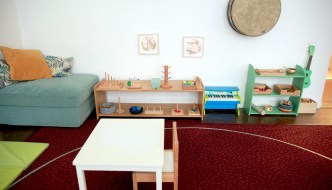
Montessori toddler work station with low shelf, table and chair, and music corner

changes:

  • These tables had to be replaced after much use and love. We now use the KRITTER tables from IKEA, which have also been shortened to stand at 38cm tall. 
  • The chairs are still the same as we have had since 2018! We have only broken 1 chair out of 15 in all this time!
  • Our wall art is now displayed in the plastic HOSTVA IKEA window frames. They are a little crooked, because we have to drill new holes after them being pulled down so many times. ๐Ÿ™‚
  • We have a new music shelf, custom built and painted by Chad (montessorimothermaterials@gmail.com)
  • The table and chair set in this area now lives in the middle of the space, with the shelves against the wall. I find this to be more inviting for the children to sit down and work.

3. Self Care Area

BEFORE

AFTER

Montessori self care area for toddlers

changes:

  • We have a different tray which allows me to separate the different materials: trying on sunglasses, wiping nose, and brushing hair. 
  • I have added a sign to the waste basket that reads โ€œdirty tissuesโ€
  • I have added a backpack, a straw hat, and a helmet to the wall hooks to offer more try-on possibilities.
  • I have a larger lotion jar now and a this little round tray to hold its place.

4. Quiet Corner

BEFORE

AFTER

Montessori quiet corner with toddler library and aquarium

changes:

  • In front of the shelf I have added a faux wool carpet, TOFTLUND from IKEA, to make the area cosier.
  • The bead tracker is in a different part of the Montessori Baby Class environment. Now we have here a large ficus plant for the students to water.
  • We have a different armchair from Verbaudet. I sewed the cushion cover from the same animal print textile because I loved it so much. 
  • We have a different ball tracker from Nienhuis now in a different place in the classroom. It its place is the scale and weights from Educo with a mystery box base, custom-made for it by Chad.
  • The books are rotated every term. Now we keep 6 small books in this area, instead of 4. We didnโ€™t have as many books back then. ๐Ÿ™‚
  • Under the aquarium we rotate the materials in each class depending on the age group. During Montessori Toddler Classes we keep two 3D puzzles.
  • The art is a print by Monet, available on Wikipedia Commons for free. It is hung in a plastic frame, the RIBBA from IKEA.

5. Newborn Movement Area

BEFORE

AFTER

Montessori Newborn Movement Area with free movement mat

changes:

  • The walker wagon has 4 rice bags which are used to weigh it down so it rolls more slowly. I sewed handles on the bags so that toddlers can practice loading and unloading the wagon when they are in the Maximum Effort stage of development. 
  • We have a new pillow in this area, LEN from IKEA. And I sewed a fuzzy pillowcase for it. This is used in Montessori Toddler Class when children pretend that they are sleeping or decide to lay down for a rest. In the Montessori Newborn Class I remove this pillow for freedom of movement.
  • The visual mobile and materials on the newborn shelf are rotated every term. Currently on the shelf we have basket of balls, basket of brushes, sensory wheel, simple threading work – (bottom), posting sticks, outlet puzzle, transparent lock and key, and wooden blocks – (top).
  • I have added a cloud carpet to the other side of the shelf for babies to work on.
  • A small, plastic FiSKBO frame is hung on the wall with Tesa tape. The art is “Girl with a Watering Can” by Pierre-Auguste Renoir, available for free on Wikipedia Commons.

In my blogpost Changes at Home When Your Baby Becomes a Toddler I have shared 3 areas of my daughterโ€™s Montessori home environment, which features the classic functional toddler kitchen IKEA hack.


Thank you for reading!

– Katelynn

Montessori Materials, The Montessori Method

Changes at Home When Your Baby Becomes a Toddler

When our baby turned 15 months old she began showing strong signs of self-affirmation crisis, or in other words, becoming a toddler. It was time to make changes in our home to support her during this new stage of life and change areas to better meet her needs. In this blog post I will share some ages and stages of young toddlers and practical life areas for toddlers at home.

Signs and expressions of self-affirmation: 

  • Walking
  • Increase in tantrums
  • Interest in practical activities/household tasks
  • Resistance getting dressed, changing diaper, brushing teeth, etc.
  • Interest in water
  • Desire to help adults
  • Can follow a 2 step process
  • Can follow simple instructions
  • Strong feelings towards and against things
  • Preference of choosing between two things, even two of the same thing

Definition of self-affirmation crisis:

This is also called the โ€œOpposition Crisisโ€ or mistakingly referred to as the โ€œTerrible Twosโ€. In a personโ€™s second year of life there is an explosion of language which parallels the self-affirmation crisis. At this moment the child learns his favourite word: โ€œno.โ€ They donโ€™t necessarily say it because they donโ€™t want something, but because they want to be respected as a individual with their own point of view. 

Changes in the child: 

  • The child starts to gain more physical control of themselves and their surroundings.
  • They understand that they are a completely different person from their caregivers and start saying โ€œno!โ€ Children test the limits and seek a deeper understanding.
  • She starts showing more uncertainty and having conflicting ideas and attitudes.
    Due to this humanisation, the child is prone to frustration and bursting into tears.
  • By three years old the ego has been nearly fully formed. By the end of this period the child will use the pronoun โ€œIโ€ instead of โ€œmeโ€ or saying his name.
    This signifies the completion of personal boundaries and the beginning of knowledge of the self in contrast to others.

Ideas for changes in the home

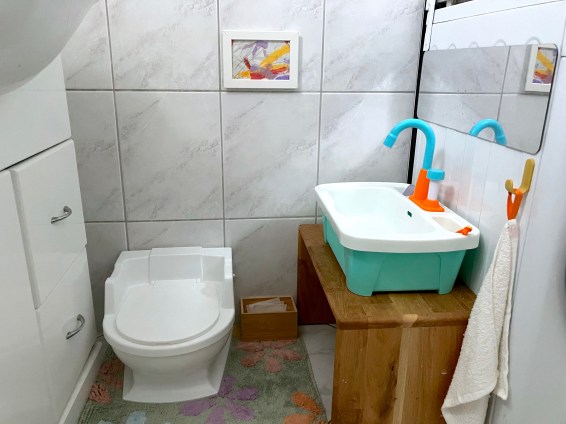
The first area we changed was in the bathroom. As discussed in the Toilet Awareness Workshop we added a simple potty, carpet, and sink to the bathroom when Jennie started walking.

Now we added a small mirror, towel hooks, wall art made by Jennie in her Montessori Baby Class, which we placed in a plastic frame. After making these changes Jennie noticed immediately and started to use this area more frequently for its intended function, rather than just exploring it.

Montessori toilet awareness, potty training, toddler bathroom, working sink

The next space was a self-care area in her bedroom. This is a small table made from a cube chair turned on its front. The mirror is stick-on plastic and non-breakable mirror. The blue container is for hair bows and is from Tiger Copenhagen. The wooden tray is from Ikea and keeps tissues for nose wiping. The wall hooks are secondhand from HM Home and the matching bags were made by hand by a friend. We use them for cream, sunglasses, hair clips and hair ties, and a brush and comb. The first day we set it up Jennie was so excited that she spent an hour exploring all these materials. She now uses this space every day. 

Montessori toddler self care area

Finally we made this little kitchen for Jennie which is still in progress. So far she uses it only for drinking water and taking her snacks, but eventually I plan to set it up for simple cooking activities and dish washing work. 

Montessori kitchen, Montessori ikea hack, toddler kitchen, functioning child sink

The kitchen is from Ikea, bought secondhand. The cutting board was custom made by Chad. The water dispenser is made of plastic and itโ€™s very easy to use. I attached it with velcro stickers so Jennie can easily push the button. I also found these lovely trays which fit perfectly, also at IKEA. The enamel trash can also comes with a cute lid, but itโ€™s too distracting and hard to open for the time-being. On the side I have attached stick-on hooks for her dustpan, broom, mini mop (from Kaufland, no link), and wash cloths. 

Finally I bought a role of adhesive foil on Amazon to add some color to the space. The mat and wall art are both from IKEA. These additions are mainly cosmetic, but making the space beautiful is inviting and attracts the childโ€™s attention. They really appreciate all the little details.

And that is all of Jennieโ€™s new practical life areas at home for the moment now that sheโ€™s a big, grown up toddler. ๐Ÿ™‚


Final Thoughts 

Since making these changes we have noticed a lot less tantrums and frustration. She is also so proud of herself when she knows where to do things and where the materials go. It was so simple and inexpensive to make these small changes for her and has made a big difference in our daily routine. 

More ways to help children during the self-affirmation crisis:

  • Activities like riding, pushing, jumping encourage their physical development. They provide opportunities for positive output of energy.
  • Offering 2 choices as often as possible helps to resolve and prevent problems without creating strife between child and parent.

    Offer two acceptable choices, for example:
    โ€œDo you want to go to the beach or to the park today?โ€
    โ€œDo you want eggs or porridge for breakfast?โ€

    This shows respect to the child because you asked for his opinion.

    2 choices also has the huge advantage of teaching reflection. The child has to consider before he answers. Starting this early helps children to be able to make bigger choices in the future. In situation when there is no possibility for choice, you must be firm and honest. Set the clear limit and enforce it consistently in a loving and respectful manner.

I hope this has been interesting and helpful!

Thank you for reading. 

– Katelynn

Classroom Tours, Montessori Materials

Introducing Montessori Preschool Class!

Example Preschool Environment: Guidepost Montessori

Montessori Preschool Class is a 2 hour weekly class for children 3-6 years old to attend with one parent or caregiver allowing you and your child to learn together and bring the Montessori approach home with you!

The class is based on Dr. Montessoriโ€™s Casa Dei Bambini, a primary school which allows young children to fulfil their whole learning potential at this critical age through child-led exploration and a prepared environment.

Our materials allow children to learn writing, reading, math, geography, practical life skills like sewing, cooking, woodworking, and so much more! In every class the children will amaze you at what they are capable of when every opportunity is provided for them. To get a picture of our materials and how the children learn through hands-on experience, see the individual areas of our expanding classroom below!

Our current collection of materials represents an introductory class environment for children 3-4 year old. As these children grow, along with our school, we are increasing our collection. We intend to open the doors to our complete 3-6 classroom in March 2023!

Our teachers are AMI-certified Montessori guides with years of experience and a profound love for each and every student. You can meet our team here

Currently we offer classes ever Monday from 15:00-17:00 and from March 2023 we plan to offer these classes every day! You can join the waiting list and receive updates by filling out this application form!

To learn more about the Montessori Mother Preschool Expansion and get involved you can find full expansion plan HERE!

Sensorial Materials

The Montessori Sensorial materials have been time-tested for over 100 years! They are one of the pillars of the Montessori approach, enabling children to refine all 10 of their senses. 

Example: 

While the child stacks the 10 blocks to build the timeless Pink Tower, he trains his motor control, his visual precision, and is introduced to the metric rule of 10. The blocks are then used as measuring tools and visual aids for the proceeding materials.


Here is one of our lovely shelves dedicated to sensorial materials.

Writing and Reading

Although in traditional schools children learn to read and write from 6 or 7, we find that the best time for children to teach themselves how to first, write and then, to read, is closer to 3 and 4 years old! From the first sandpaper letters to the grammar analysis materials our students are reading books by 6 years old and they LOVE it. 

Example: 

A 3.5 year old child starts with a puzzle then uses our wooden letters to match the starting sounds of the words to their letter Peach, Cherry, Watermelonโ€ฆ. Then crafts those letters out of clay or writes them with a water paintbrush onto a chalkboard. A passion for calligraphy and the intrigue of sounds and their symbols continues and grows until the child can write their own name cards to match to their pictures.

Here is one of our shelves dedicated to writing materials where you can see our tracing letters, wooden moveable alphabet (on top) and all of our writing materials. The bottom shelf holds more sensorial materials for refining the tactile and visual senses.

Math

There are SIX groups of math materials in the 3-6 classroom: numbers 1-10, decimals, counting, abstraction, memorisation, and fractions. Starting with understanding quantity and the number symbols, by the end of their time in the Montessori Preschool Classroom, children have learned to divide numbers by the thousands! 

Photo: our shelf dedicated to the introduction to numbers 1-10. As you can see this is just the start of our mathematics area because it is one of the largest and most expensive parts of the primary classroom. Our focus currently is teaching all the students to recognise the numbers and have a strong understanding in concepts of quantity, adding, and subtracting numbers from 0-10. 

Geography and Biology

This is one of my favourite areas of the preschool classroom as our international community includes families from every continent. Children not only learn the countries, continents, landforms, and bodies of water, they learn about the cultures, animals, plants, foods, et cetera which come from each place. 

Example: A three year old child chooses a country from map puzzle and finds it on the globe. Then they find the flag of that country, the corresponding animal replica, name card, landmark replica, and photo of a view of that country. Although they might not have been there, they build a knowledge of that place and a respect for its culture, widening their world view with every minute spend working in this area of their classroom.

We currently have the first globes, maps, and early puzzles in rotation on our shelf, but this is an area I plan to expand on significantly in our classroom and include a geometry cabinet of all kinds of objects and photo cards to be sorted and grouped with the continents, countries, and ocean puzzles.

Practical Life Skills

Practical life is the link to the classroom for toddlers entering the preschool environment. At three years old the children are already familiar with cleaning, cooking, and self care, and this area includes all their favorite materials with an elevated level of challenge. New materials include ironing, polishing silver, sewing, woodworking, tending the garden, grinding spices and making tea, and so many other beautiful activities which allow the child to learn lifelong skills. 

For example: The child knows how to thread beads using a needle – now those skills are elevated to embroidery and perhaps the child will use them to sew a purse or pillow or weave a cloth on the loom. 

The practical life area in our classroom extends throughout our entire school as the children have their own complete kitchen, washroom, woodworking bench, herb garden, cleaning area, self care area, various washing stations, and of course, this shelf of lovely materials. Children can use their materials to polish, sew, wash, grind, grate, braid, screw, spray, and explore their curiosity whenever they want. Thatโ€™s why this shelf is found right in the middle of the room. 

Art and Music

Our art shelf continues to offer interesting opportunities for children to develop their creativity. We also have a music shelf complete with various instruments. In the future we plan a large expansion of our music area to include materials for learning notation (how to read music) and discern the notes on the scale using their auditory sense.

Food Preparation

Every class children enjoy a meal which they help prepare together. Children can also prepare a snack for themselves or use materials to make clay or pasta. The table is beautifully set by the children with flowers they arrange themselves and the napkins they have ironed and folded. This is perhaps the greatest visual of their great capacity for independence and mutual consideration. 

Our classes are fully equipped in this area already and in the future we plan to set up a full child-sized kitchen complete with countertops, a mini stove and refrigerator. ๐Ÿ™‚

Grace and Courtesy

Grace and courtesy is a fundamental concept of Montessori, which is an education for world peace. The activities promote self awareness and social awareness through control of movements and exercises of sound and silence. The two most well known are the ceremony of passing the bell (without making it ring) and walking the line (without faltering). 

Here is the line weโ€™ve set up on our carpet which is home to all of our hellos, goodbyes, and exercises of grace and courtesy. 

& more! 

In addition to all the wonderful areas of our classroom above, we also plan to have the following in our new expanding Montessori environment: 

  • outdoor garden to teach horticulture and give a farm-to-table experience
  • climbing wall for gross motor coordination and spacial awareness
  • water lab for fun and experimentation with volume, pumps, and gravity

The Montessori Movie

Would you like to see a Montessori Preschool in action? This documentary follows a Montessori 3-6 classroom in France for one year and it is truly moving to see what children achieve after just a short time in this beautiful school.

Stream HERE: https://www.montessorimovie.com/


Thank you for reading! 

– Katelynn


Sources

The photos of our environment are property of Katelynn Johnson. 

Other photo inspiration is property of Guidepost Montessori and Let the Child Be the Guide

The Montessori Method

Montessori Sleep: FAQ

A Montessori Sleep Environment for 6+ months

In this blogpost I will be answering these frequently asked questions anonymously and I will give advice based on Montessori theory. This doesnโ€™t mean that itโ€™s the perfect solution for you, every family and every child is unique, but I will do my best to give helpful suggestions and if those suggestions feel right for you, then try them out.

Listen to the podcast:

Sleep is such a personal topic . It is a skill that all children have to learn. The relationship your child has with sleep affects the whole familyโ€™s mental and physical health so making changes regarding their sleep situation should involve the whole family. Communicate with each other so that everyone is on the same page and whatever you decide to do is the right solution for everyone, parents and children.

Question 1

My baby is 5 months old. She only falls asleep when I am cuddling with her, not my partner, just me. If I am not there she will cry 95% of the time. What should we do to help her find sleep by herself or with my partner?

  • Children can easily get used to one thing that they need to go to sleep. This can be cuddling with a specific parent, like in the example above, it can also be a pacifier, a lovey, milkโ€ฆ It doesnโ€™t mean that they canโ€™t find rest another way, they just have to re-learn how to sleep without that attachment. Believe in your child that they can do it. 
  • Their whole life they have slept one way, so changing that understanding will take some time. On top of that, they have to process this new information when they are tired and probably when the parent is tired also which makes it even more challenging. Communication, patience, and complete calm are so important in this process. 
  • Make a change that your family has decided on, go to bed early so they havenโ€™t passed exhaustion, and stick to your plan so it doesnโ€™t send mixed/negative messages. You can do this!
  • You can make a plan to take it slow. For example, start with day sleeping, then move to night sleeping. Instead of getting in the bed, sit next to it and offer comfort and closeness this way. Let the child feel all of their feelings about this process without judgement. If there are tears, let them be expressed and show compassion. This is your childโ€™s way of saying โ€œI am tired and I am having a hard time.โ€

Question 2

How should I set up a Montessori sleeping area?

  • In Montessori we use a low bed or a floor bed which is a mattress on the floor, on a carpet, or on a base which is only slightly higher than the floor. Eventually baby moves to this bed as they transition to independent sleeping. 
  • The sleep area is should be in the darkest, quietest part of the room. 
  • Make the space functional and inviting. 
  • You can keep some books nearby in a basket or on a shelf for reading before bed. There shouldnโ€™t be any noisy or highly stimulating toys in the sleeping area – this is a place of quiet where the child knows they can go if they need to find rest.
A Montessori Cestina (sleeping basket) for babies from birth to rolling

Question 3

How and when should we transition from crib sleeping to toddler bed sleeping?

  • Make this transition when you feel your child is ready and when you are ready to commit to the transition which can take some time.
  • When the child is walking they should be able to get in and out of bed independently. 
  • Step-by-step: Remove the crib and introduce the bed in the same day. You can invite your child to help you or they can observe what you are doing passively. 
  • Talk about how โ€œYour โ€˜new bedโ€™ is in this box. We are going to open it and put it in your room so you can sleep there.โ€
  • Say โ€œGoodbye!โ€ to the crib with your child so they have the memory of it being gone.
  • Put the new bed exactly where the crib was before if you can. 
  • On the first few nights, go to bed a little bit earlier and prepare yourself (what you are going to say + your positive attitude) for coming into the room several times before they fall asleep. You will have to remind them that itโ€™s time to rest, go back to bed, and tuck in every time in the exact same way. ๐Ÿ™‚
  • Keep a neutral attitude of calm and acceptance. Itโ€™s just a new bed, not an overly exciting or a bad thing. This will also help your little one accept it.

Question 4

How and when should we transition from co-sleeping to independent sleeping alone?

  • If this is what your family has decided is best for you, you can make this transition when you are ready to commit to it. It can take some time and no matter when you decide to do this, it will be a learning process for your little one. If your family is happy with co-sleeping and it works for you, then you should continue it! There is no 1 right way to sleep.
  • Explanation: Co-sleeping is family sleeping, so often itโ€™s difficult for the child to learn how to fall asleep when the family is not right by them and that they have their own bed now where they sleep alone. 
  • The first step is to get them their own bed, talk about it, show where they can put their headโ€ฆ โ€œThis is your own bed. When you are tired, you can come here and rest.โ€
  • Donโ€™t get into the bed yourself, because it is a place where only your child sleeps.
  • Start with day sleeping, sitting near the bed if they want closeness. Gradually give more and more space until they are sleeping there fairly comfortably. Use a specific routine before they get into bed to sleep. (For example, lunch, brush teeth, change clothes, read books, sing a special song, give a kiss, then itโ€™s quiet time.)
  • Begin changing the night sleeping by giving information and going to bed early. โ€œTonight you will sleep in your bed and we will sleep in our bed.โ€ Use the exact same routine as you do before a nap.
  • If they are upset, be their calm and give them the words to explain how they are feeling. โ€œYou feel tired right now and itโ€™s hard to get to sleep. I am here for you.โ€

Question 5

My baby is 13 months old and he wakes up every 2-3 hours. We are a co-sleeping family. How can we help him to have a more normal sleeping pattern? It feels like everything is on pause until we can sleep through the night.

  • The sleep cycles of a child this age should be longer than this so itโ€™s a sign that they are waking up for a reason. 
  • There are many reasons why toddlers could wake up in the night:
  • digestion – their tummy is upset or they have food in their stomach so their rest is not quality
  • they are waking for a bottle (they donโ€™t need to eat at night any more at this point, so slowly give less watered down milk until they no longer feel hungry at night.)
  • they sleep with a pacifier or lovey and itโ€™s fallen out triggering their wake-up response
  • they are feeling discomfort – teething, sickness, overheated, uncomfortable
  • they have had a bad dream
  • they have woken themselves up with their own movements or by the sleep noises and movements of the other people in the bed (If this is the case, perhaps they need their own sleeping space away from the noise and movements of others – which is OK if thatโ€™s what they need. There are no rules on where or how to sleep.)
  • I recommend saying โ€˜goodbyeโ€™ to sleep props/associations
  • Communication: Encourage independence by teaching her how to find rest without waking you up. Teach her what you do when you wake up in the night.
    – keep a waterbottle nearby the bed
    – teach her how to flip her pillow over
    – take off socks
    – roll overโ€ฆ

About using a pacifier or other sleeping props:

  • Say โ€˜goodbyeโ€™ in a respectful way. Itโ€™s a real and strong attachment your child has, so treat it with love. 
  • After 3 difficult nights, itโ€™s usually over with.
  • If they use the pacifier other than at night, start by using it not using it during the day, then for night sleep, and finally for day sleep. 
  • You can also say goodbye to the pacifier all together at once!

Question 6

My baby is 17 months old. She sleeps alone in her bedroom but the bedroom door is closed so she has to cry to call one of us when she wakes up.  How can we give freedom without creating a bad habit of leaving the room during rest time? At night, would it help if we open his door before we go to bed, so he can go out and find us when we wakes up? How about at nap time?

  • This is a good idea to open the door when itโ€™s time to wake up and let them come out when they are ready.
  • You can also try leaving the door cracked after you say โ€˜goodnightโ€™ and if they get up, remind them to itโ€™s time for sleep and going back to bed.  See question #3
  • Perhaps you can add a long extension to the door knob so they can open it alone.

Question 7

My son sometimes sleeps either naked or topless when he refuses to put his pyjamas on. I don’t force him to put on his pyjamas if he resists. Should I insist on this as part of the routine? Are there unintended consequences of me agreeing to let him sleep without pyjamas on?

  • This depends on you. If itโ€™s okay for you, then yes. If itโ€™s a limit for you, then no.  Always sleep with some protection like a diaper or training pants. In the summer itโ€™s hot and lots of people donโ€™t wear pyjamas.
  • Personally, I think itโ€™s fine – Itโ€™s the childโ€™s choice. Offer them to put on pyjamas and let them decide if they want or not. 

Question 8

My toddler wakes up at 5:30am. Why is he waking up crying?  Why so early? How to help him understand that morning starts at 7.30 and 5.30 is still night? How can we help him to wake up happy saying hello?

  • 6am is a pretty normal time to wake up in the morning for toddlers. Their best sleep usually takes place between 8pm and 6am. 
  • See question #5 for reasons why your toddler might be waking up. 
  • Waking up early could also be part of your childโ€™s bodily rhythm. If possible, prepare the environment so when he wakes up he can prepare himself a snack when he wakes up or play independently. If the environment is safe, itโ€™s okay to say, โ€œI still need to rest. You can relax here with me or you can go prepare some fruit.โ€ 
  • If possible, change your routine to go to sleep earlier and his routine to go to sleep later so you can wake up at the same time. 
A reversible Montessori floor bed (by Montessori Mother Materials)

Question 9

Why does my baby wake up every hour screaming? Itโ€™s as if he is afraid of being alone even though he is in a familiar and safe environment and has never had any traumatic experiences around sleep.

  • When a toddler passes out from exhaustion, this sleep will be more restless and involve more wake-ups at night. 
  • Waking up suddenly and crying is a natural response which comes from an instinct to react to threats of danger or being alone. The fear of being alone is a natural fear in all children . It isnโ€™t only a sign of trauma. 
  • Communication before bed โ€œI will be in my bed and come say good morning to you. โ€œ โ€œYou woke up and felt worried. I am here for you. Spend time in the bedroom for a while before and after sleep so the room is not only a place of aloneness. 
  • Always be calm and understanding, translate her emotions, meet her where sheโ€™s at, let the fear pass for her and keep going with the day. 
  • The childโ€™s emotions are very powerful in the moment, and when the moment has passed the emotion will have passed. Take a step back to observe how they are feeling, help them work through their emotions, and be their calm.

Question 10

We have a night routine and my toddler knows it very well. However, every night is a fight. Heโ€™s exhausted because he only sleeps 30 minutes to 1 hour during the day. He wakes every 2-3 hours crying or calls me for cuddles. How can I help him find rest? He is too stressed and so I am. 

  • It sounds like in this situation it becomes very had to manage because both child and parent are exhausted. 
  • Try to go to bed before reaching the point of exhaustion. Try to help them not get overstimulated during the day, which will help him relax at the end of the day. 
  • Crying is a natural form of expression and we can respond to it with 
  • Make sure that all of his sleeping situations are consistent so he can make the associations with where and how to find rest. 
  • If the tantrum every gets to much for you to handle, leave the room for a few minutes. Calm down, listen to a song or drink a cup of tea. Come back and explain โ€œI was feeling overwhelmed and I needed to have a calm moment. I feel better and I am here for you now.โ€
  • Crying is a normal and healthy form of emotional expression. Be there for your toddler as they release all their emotions. If they push you away, give them space and let them know that you are nearby if they need you. 
  • Every time he wakes up you donโ€™t need to run in straight away. Try to understand the cries and see if he needs something or is afraid. If heโ€™s just woken up and is not really upset, give him a couple of minutes to see if he can get back to sleep by himself. If not, observe how he is feeling + if he needs anything, help him work through his emotions, and be his calm. 

Question 11

How will my child manage to sleep with a caretaker (kita, tagesmutter, babysitter)? What can I do to help?

  • Make sure that both you and your child trust the other carer completely before they start putting them to sleep. If you feel comfortable with the way they are going to put them to sleep, it will help your child to feel secure. You can help them to have success by giving information about your childโ€™s sleep routine. Hopefully in day care they will not insist that the child has to fall asleep at first, but offer quiet rest time. 
  • Sleeping in this new way will become part of their normal daily group routine. Believe in your little one and trust that they can do it. 

Conclusion

At this age babies and toddlers are still not usually sleeping the same way that adults do. We would love for them to, but physically many are still developing the ability to sleep through the night. Sometimes they need help to learn how to get to sleep and how to get back to sleep when they wake up. The key is communicating with your partner, making a plan, and being consistent with your plan. Change, especially around sleep is difficult because the child is having to learn and process information while they are already tired. At first it will be hard but it will get better and you will be able to sleep through the night, at least hopefully, 80 percent of the time. ๐Ÿ™‚

All of your had work will pay off and your child will learn how to relax and sleep when they are tired, a skill which will help them their entire life.

Thank you for reading! I hope that you found this interesting and helpful. Feel free to reach out to me if you have any questions. 

-Katelynn

Montessori Materials, The Montessori Method

How to set up a Montessori play area at home (from birth to 3 years)

What are the reasons for using Montessori education at home?

1.Our absolute main goal is to support the childโ€™s mental and physical development. First we are aware of what the childโ€™s needs are, and then we prepare the space for them, so that they can follow their natural path of development with everything in their environment is available to them to use to meet each developmental need. 

2. Understanding the child also makes parenting them more peaceful and more joyous because it takes away our struggles and frustration of every-day tasks like getting dressed, going off to sleep, etc 

3. At home, you are often able to allow your child to have more control over their learning than they have at school. When children have more control over their learning, they are able to face challenges, grow their creativity, and become more resilient. They have to be self-aware, resourceful, and confident in their capabilities in order to solve their own problems. 

4. Finally, Montessori is an education for life and gives children a love for learning so that they can succeed in every other area of their life. 

Parts of the Montessori 0-3 Environment

When we talk about the home environment from 0-3, we are looking at 4 general zones of the childโ€™s space. They are the sleep, care, food, and movement areas. In this blogpost, we are going  to focus mostly on the movement area because thatโ€™s usually what people think about when we talk about Montessori and the other areas can be different for every family.

The toddler (5m-walking) play area includes…

ยท low, light-weight table and chairsprovides a comfortable place where the child can focus on their work
ยท cleaning suppliesteaches responsibility and allows child to do practical life work
ยท toddler shelf with 6-10 materials organises the toddler’s materials for most success
ยท easelprovides a comfortable place for artistic expression
ยท access to water sourceallows the toddler basic access to drinking water and water for practical life (just a small amount)
ยท plant with watering canteaches how to care for nature
ยท 3-8 books on a low Montessori bookshelf or basketchild can grow a love for reading
ยท wall art hung at eye levelbeautifies the space + gives visual information
ยท reading loungegives the child a comfortable place to enjoy their books

The baby (5m-walking) play area includes…

ยท larger movement mat or regular carpetallows Baby to move freely, easily, and safely
ยท mirror on the wall with pull-up barprovides motivations and opportunities to stand
ยท low shelf with 6-8 materials organises Baby’s materials for maximum success
ยท push wagonallows Baby to walk independently and practice balance
ยท tactile mobilestrains the grasp and supports concentration
ยท plant with small watering pitcherteaches how to care for nature
ยท 3 books on a low Montessori bookshelf or basketchild can grow a love for reading
ยท wall art hung near to floorbeautifies the space + gives visual information
ยท place to climbstairs, a Pikler triangle, or bridge offer a defined climbing area

The newborn (0-5m) play area includes…

ยท firm movement matallows Baby to move freely, easily, and safely
ยท low horizontal mirrorgives visual feedback on movements; allows Baby to see more of the environment
ยท low shelf with 3-6 materials or booksprovides motivation to crawl
ยท visual mobilesgives gentle stimulation and supports visual development
Montikids $60 off code: MONTESSORIMOTHER60
ยท plantshares an appreciation for life and nature
ยท wall art hung near to floorbeautifies the space + gives visual information

I hope you found this helpful and interesting! I will go more into detail about materials and other zones of the environment in separate blogposts.

The Montessori Method

Translating for Toddlers

The interpreter is to the child a great hope, someone who will open to him the path of discovery when the world had already closed its doors. This helper is taken into the closest relationship, a relationship that is more than affection because help is given, not merely consolation.โ€

Maria Montessori. The Absorbent Mind. 1949

Listen to the podcast:

Understanding their position

Compare yourself to living in a country where you do not speak the language. Many of us can relate to the frustrations the child could feel when… 

  • things happen to them which are not explained
  • instructions are given hurriedly without being shown
  • being treated by speaking people as if disabled because you cannot speak the language
  • wanting to say something important but you donโ€™t have the words

Understanding their reactions

In these situations I may not have much self-control; I may become agitated, enraged, and begin to cry. That is what happens the child of one or two years old who has tantrums. They are intelligent and know people could understand their ideas, but cannot express them through lack of language. This is a dramatic epoch in the life of the child. (Maria Montessori, The Absorbent Mind)

Do not misinterpret the child expressing their frustration as deviant behaviour. They are facing a great struggle and feel comfortable enough with you to let you know how they feel and ask you for your help to calm down. Imagine how misunderstood they must feel!

One word sentences

Around 1.5 years old, toddlers realise that every object has a name. They use one noun to express a whole idea. Letโ€™s call this form of self-expression one word sentences. These words are also often abbreviated or altered. When we respond to these sentencesโ€™ translations, we give the child reassurance that they are being understood and we bring them calm.

Thank you for reading! Let me know if you have any comments or questions!

Uncategorized

What Your Child Is Capable Of : from birth to 18m

Listen to the podcast:

Maria Montessori spoke extensively on the great potential of the child. She explains the amazing ability children have to absorb everything they experience in the first years of their life. She also wrote about the Sensitive Periods they go through, which highlight each childโ€™s perfect moment for mastering a skill- from great feats like walking and speaking to achievements in independence such as potty learning or self-dressing. 

The chart I have made follows the sensitive periods for movement and language from birth to 18 months old.  It is a month-by-month guide, sharing some of the things children do during these months and a few Montessori activities which are appropriate during each stage of development. 

However it is important to remember that every child has their own perfect timing to learn to turn, crawl, walk, and talk.  As always in Montessori, our purpose is to follow the child

When we are aware of all the things our little ones can do, it makes it possible for us to truly trust them and give them the space they need to grow and the opportunities they need to apply their full potential.  

So what can we do to help our babies?

We know that Babies and Toddlers are happiest when they have a stimulating environment that challenges them, but doesnโ€™t overwhelm them, which offers understanding, and allows them to have success and also feel joy from their accomplishments.

1. We can offer a safe space for them to learn and discover.

newborn movement area at home

~ for newborns and small babies we set up a movement mat on the floor and a low mirror which allow them to see and feel their unrestricted movements, clearly.

~ when they start crawling and walking we clear the floor for them so they have enough space to move around. If possible we prepare a whole room or part of a room which is completely safe to let them explore freely.

The key to this is trusting your child and also trusting that the space you have prepared for them is truly, completely safe. 

2. We can provide activities that help Baby learn and perfect new skills.

advanced rings of graduating size on a stable base (2 years old)

I will give one example for the newborn, baby, and toddler stages:

~ newborns train their eyesight with Montessori visual mobiles
At birth babies can only see high contrast and they canโ€™t change their focus. Mobiles like the Munari , which are black and white and move naturally with the air in the room, are slow enough for them to follow and see clearly. 

~ A couple of months later babies are improving their grasp and release with ring on dowel activities of increasing difficulty.
They start with one large ring on a stable base around 6 months old and eventually work up to several small rings of graduating size in a basket next to a stable or rocking base around 14 months old.

~ and walking toddlers grow their independence through practical activities like washing hands and slicing bananas.
They are very interested in taking care of themselves and taking care of their environment so we set up activities for dressing for self feeding, food preparation, cleaning, caring for plants, and lots of other exciting opportunities so that they can have success in these daily tasks which are so fascinating for them.

3. We can remove any obstacles which might be holding Baby back from taking steps in their development.

The most common obstacles I have found in my work with children are clothing, interruptions, and safety

~ I mean so say clothing that is too loose or too tight is a common obstacle thatโ€™s very easy to remove – literally.
When a baby is learning to crawl, they really need to have their forearms and legs open to make contact with the floor and move forward or backward successfully. When they are learning to walk long pants can actually trip them or socks can be slippery and cause them to fall down which is not very encouraging to a child who is trying to learn to move.

~ interruptions like distracting sounds or movements prevent many babies from being able to enter a concentrated state of learning and repetition. Some children are more distractible than others so itโ€™s important to be mindful of this.

~ Safety is the biggest obstacle babies face in their development  because if we, the adult, see a potential danger we are likely to stop them from touching that thing instead of finding a more appropriate place for them to explore it.


In Montessori we see any state of repetition as a sign that the child has a developmental need which MUST be perfected. So if you notice your baby doing something over and over again, we HAVE to allow them that privilege, but in an appropriate place. 

Thank you for reading! I hope that you found this discussion to be useful, whether youโ€™re a parent or a teacher and that we can be reminded to trust in the amazing potential the child has and let them use their Absorbent Minds from the very, very beginning.