Parent Information, The Montessori Method

Freedom & Limits: from birth to 18 years old


In this blog post you will find my notes from the 2024 Nienhuis Retreat and the lectures from some of Europe’s best AMI Trainers from 0-18. They are incredible women with decades of experience who have trained hundreds of teachers around the world. They are Patricia Wallner, Madlena Ulrich, Carla Foster, and Jenny Marie Hรถglund. ๐Ÿ’› ๐Ÿ’› ๐Ÿ’›

PDF Versions | 0-3 | 3-6 | 6-12 | 12-18

freedom & limits in the first 3 years of life

notes from Patricia Wallner’s lecture

  • The ages 0-6 and 12-18 are stages of creation – during which freedom and limits are necessary for the formation of the individual.
  • Freedom is something everyone wants – economic freedom, professional freedom, spiritual freedomโ€ฆ. But we cannot do anything we want without consequences. The limits are those that we accept within our community (family, school, neighborhood…world) and learn to live within.
  • In Montessori, as it should be everywhere, the child has the freedom to move, to stay on a task as long as they want, to order one’s own actions, and to develop their will.
  • Of course, as the child’s freedom expands, as do their responsibilities and need for self-discipline, but fundamentally their freedom is of that of the individual to have unlimited possibilities for growth and improvement. This freedom should be the basis of human society.

The only true freedom for an individual is to have opportunity to act independently.โ€

– Dr. Maria Montessori, Education and Peace, chapter 7

  • Adolescents have the freedom to develop into a fully functioning, independent adult. This is a process which begins in the first 3 years of life. 
  • The toddler’s journey to freedom begins at birth. The toddler has the freedom to work with their hands, to find functional independence, to do practical life tasks, to fall asleep when they are tired. There are built-in social limits to learning how to be social, but within those limits – there is a lot of freedom.
  • The child does everything to become an individual of their time and place. 
  • Everything is tied by protective laws which render freedom possible. Fish are the most free of the living beings in the world, yet they cannot get out of the water. 
  • Dr. Montessori describes physical freedom as to be free from the teacher and the parent, free of being under constant influence of another person. They must be free from being dependent. Dependence destroys personality. {Education and Peace}

Organic freedom in necessary to sustain physical freedom (maintaining and sustaining the body).

Then psychic freedom becomes possible. For this an education which follows the laws of development is required with a guide who knows what is psychologically appropriate for each plane and how and when to work with them through each milestone.

Then comes intellectual freedom which is spiritual and intellectual independence, or the birth of the adult.

  • Freedom is an exercise of the the will, making choices based on understanding. But freedom is not a gift to the child from the adult, but the child’s own conquest.
  • Nature provides babies with a vital impulse that drives them. The parent is happy to do everything for them, but the baby fights to roll over, to pull up over and over, without anyone telling them to.
  • The child in their first 3 years of life is called the unconscious creator – one who doesnโ€™t know that they are learning. Gradually the reasoning mind catches up with the unconscious mind and from 4 years old, the child is guided by the reason. The reasoning mind is present from birth, but it is not in control. The child develops it through living and building their knowledge, knowledge they start absorbing in the womb.
  • The vital impulse driving the 0-3 child to learn is called their Hormic will. This and their Absorbent Mind allow the child to incarnate everything they need to learn and everything we want them to learn, such as the rules of life and language.
  • How the child is born and raised will always be the most comfortable way for them to live because this is what they have incarnated. They will learn more through life, but nothing will have the same long term impact like the unprejudiced way in which they absorb their own culture, for example.
  • When parents teach rules by saying โ€œNo! Stop!,” this is the way they will teach rules to others. Active discipline is when the child is in control of themself – when they are internally motivated to follow the rules. 0-3 year old children donโ€™t understand the whole world, so parents still need to give the rules so the child can adapt to wherever they were born (language, habits, food, climateโ€ฆ.). The child is open to everything and develops their own discipline. The adults in their life have to model everything the way we want them to do it. 
  • Children watch us all the time. They have 86 billion neurons. They are listening even when you whisper. The Absorbent Mind takes in everything. Children repeat what we say. Thatโ€™s why even as an adult, you might find yourself saying something your mother always said to you, even without intending to. You incarnated that as a child. 

You have to set limits, giving just enough information so the child knows what you are talking about. ‘You must walk inside. We can run outside later.’

โ€œDo not fear to destroy evil. It is only the good that we must NOT destroy.โ€ – Dr. Montessori

โ€œIf there is some child who persistently annoys the others, the most practical thing to do is to interrupt them.โ€ (Dr. Montessori, The Absorbent Mind, ch. 27)

“A childโ€™s liberty should have as its limit the interests of the group to which he belongs. We should prevent a child from doing anything which may offend or hurt others or which is impolite or unbecoming.” (Dr. Montessori, Discovery of the Child, ch. 3)

Donโ€™t allow child to MISUSE the materials. Allow them to USE the materials.

Be aware of how you stop chaos. Act. Donโ€™t react. 

Adults can make strong connections too, even without the Absorbent Mind. The way you interact with children will get stronger and stronger with practice. Teach yourself to use certain phraseology. Adjust yourself to the childโ€™s level. You wonโ€™t have to think about it. Train yourself to interact in the right way and model correctly when you are with the child. 

Babies CAN concentrate. As long as they have the right materials in front of them. 

โ€œLet us remember that inner discipline is something to come, and not something already present. Our task is to show they way top discipline. Discipline is born with the child concentrates his attention on some object that attracts him.โ€ (Dr. Montessori, The Absorbent Mind, ch. 26)

  • Toddlers need more time to process information than other age groups because their language is more limited than other ages. You can only say one thing to them at a time, no sequences. Speak slowly. When you put on coats, donโ€™t talk about where you are going, wait until you are on the way. Give information and repeat it. 

    Letโ€™s go downstairsโ€ฆโ€ฆ We need coats โ€ฆโ€ฆโ€ฆโ€ฆ. Which hat do you want to wear?โ€ฆโ€ฆโ€ฆ. Letโ€™s go to Grandmaโ€™s houseโ€ฆโ€ฆโ€ฆโ€ฆ.. Do you want to walk or ride in the wagon? 
  • Not every child in the world has to look at you while you are speaking. You should know if they are paying attention, whether they are looking at you or not. That is an archaic Western tradition. 
  • Around 2 years old, the child is completely separate from the parent and the Ego is formed. Their favourite word is ‘No’. They want to be heard. They want to have a say in everything.
    You can put on your coat. Or I will help you put on your coat.
    NOT Put on your coat or I will leave without you. (Then you will have to actually leave without them. Which you wonโ€™t do. So you will lose your credibility.)
    This only applies to children under 3.
  • What do you do if the child rejects your idea? You have to set the limit. Tell them nicely:
    Please stop kicking the wall. Either you stop kicking the wall, or I will help you move away.
    Speak to the child the way you would want someone to tell you to stop kicking the wall if you were having an emotional breakdown.
  • Set rules simply by saying:
    We donโ€™t climb on the table.
    We donโ€™t run in the kitchen.
  • With a toddler who can understand more complex language: set the limit, explain the choices, think the situation through, and assist the child to comply.

More about Patricia Wallner’s work HERE


freedom & limits from 3-6 years old

notes from Madlena Ulrich’s lecture

  • In order to be able to follow limits and show responsibility, the child must develop the will so they can relate to the rules that are applied to our group.
  • The will is the desire or inclination to do something. Willpower and will are often used interchangeably, but they are different.
  • Will is the inclination but will power is the power to direct the will to do something or continue to do something in the face of hinderances or distractions.
  • When we do something “of our own free will” it means that we have done it voluntarily and it also means we have considered options. Do I do it or not? Exercising your will means you have considered options and have made a choice.
  • Self control is the ability to regulate your thoughts and behaviour in the face of temptations. We have the ability as adults to give ourselves little rewards if we show signs of self-control. If I do that, then I can do this. Before I watch the news, I will finish this assignment. After I finish this task, then I will have a cup of tea. You use the will to push away distraction, but still require a reward after.
  • Being strong-willed is sometimes considered to be a negative trait by adults when a child is not doing what the adult wants them to do, if a child does the opposite of what we want or is hard to direct and need rewards or punishment to do what the adult wants them to do. However, we also admire people with a strong will, those who have risen above society.
  • Montessori thought a strong will is a positive thing. It means that you have a strong connection to your own will and your own needs, whereas a child with a weak will might allow themselves be guided and and will follow their peers or obey orders.
  • In Montessori we believe that we should help the child to develop their will, to become in charge of their own actions, to be able to stop themselves from doing what they are not supposed to do and challenge themselves to do what they must.

Practical Application:

  • Lots of children’s games are about training the will and executive functions.
  • The Montessori classroom allows the child to be able to focus on what is essential and to be able to adjust their own feelings and emotions.
  • We use our will to calm ourselves down and to wake ourselves up and to adjust.
  • We encourage the children to practice creative problem solving. What is plan b.,c., and d. and how can I adjust?
  • The child should learn to trust themselves and to build their self-esteem. Without self-esteem the child might not act upon the will. Strengthening their will power builds resilience, allowing them to continue their work even when they make mistakes.
  • The child needs to have a feeling that they are doing something deeply meaningful.
  • Babies canโ€™t control their emotions and need to build up these skills in order to regulate their actions in 3-6.
  • During the first year of life, the child doesnโ€™t have control over their hormone system. Their sense of external feeling of safety is given to them by the adults in their environment, for example the calming and singing voice of their father.
  • When they become toddlers they begin to learn how to be aware of and regulate their emotions.
  • At age 2, the will starts to form.
  • We can see that the child’s actions are not based purely on impulse, but on a decision. Now that the child has found their will, they exert it as much as they can. For a toddler itโ€™s new and they donโ€™t know where or how to use it. They tend to over-use it. They say “no” to every question. This is actually a very important stage.
  • At this beautiful and exciting stage, the child is becoming aware that they have a will. It feels to them like they could change the whole world with the word ‘no’. The child with their new power needs to practice the use of their will. This coincides with the maturation of the prefrontal cortex. I want a cookie but my parents told me that I can only have a cookie after dinner. 
  • A childโ€™s development in this area is very dependent on the caregiver. The child may have a strong will but it is still hard work to use that will in the face of temptation. Itโ€™s even hard for some adults.
  • Practical life activities provide the 2-3 year old child with the intelligent direction of movement. These materials are essential in the development of the will. I am moving my hands over the table with the soapy water to eventually cover the whole table with suds. I am building the pink tower by moving one block at a time. I am going to continue scrubbing that whole table until its washed and then I will continue tidying up until everything is back on the shelf.

Support the child’s will with enthusiasm.

Give the child time to make their decisions and donโ€™t give too many choices. 

Obedience:

  • Obedience is the ability to regulate yourself and to follow the needs or requests of someone else.
  • Blind obedience is not a good thing. But the child must learn a willingness to listen to others, consider what they say, and decide whether or not they should act upon what they said. Obedience really means that the child knows they need to do something and they can do it, even if they don’t want to because they know that it is important. My teacher says we need to tidy up our work – I donโ€™t really want to, but I know itโ€™s true.

Levels of obedience:

  • level 1: the child obeys if their needs are in accordance with the requests.
  • level 2: the child obeys as long as you donโ€™t turn your back.
  • level 3: the child obeys without being asked, because he sees the needs.

Development of the will:

  • level 1: instinctual behaviour of the newborn that needs the adult to build up the ability to self-regulate
  • level 2: deliberate action when the child starts noticing the needs of other and occasionally acts upon them โ€ฆ if they feel so inclined at the moments and then around 2 it turns more into internal motivation.
  • level 3: the child becomes aware of the impact of his actions on the environment. If I push my friends while we are standing in line something unpleasant will happen and thatโ€™s not positive so I am checking myself even though I am impatient right now.

When the child is not doing what we want, we must consider which stage the child is in the development of obedience and their will. that development and ask ourselves, “Do my wishes line up with that childโ€™s?” Some children have been given very little opportunity to regulate their will. For example, some adults think that a little child should not have to struggle with are putting on their socks or putting their own work away. This child may consequently have a delay in their development of will and obedience.

Respect childโ€™s pace.

Respect childโ€™s ability to self-correct and to build self-confidence and resilience.

Observe.

Respect the childโ€™s concentration.

More about Madlena’s work HERE


freedom & limits from 6-12 years old

notes from Carla Foster’s lecture

  • We are responsible for our freedom.
  • Dr. Montessori defines freedom as an environment which is conducive to the most perfect conditions and the freedom which allows life to develop.
  • If this is not obtained, then the child’s adaptation is based on captivity.
  • Experiment:
    Teachers went to children in small group and asked the children what they thought freedom meant. The children had a primitive understanding that it is just doing what they want. We thought about what assumptions were the teachers making when they say you have freedom here as long as you take responsibility. They hadnโ€™t talked to the children about what lies beneath that freedom and responsibility concept.
  • Children need activities that require effort. With every gained trained movement, you gain a freedom of movement. Itโ€™s always effort even when itโ€™s easy.
  • For the child of 6 years old, much of their learning has seemed effortless. They seem to have forgotten all the times they fell down when they were learning to walk.
  • We often forget all the effort we went through to learn what we have. Now this current effort is tiresome, because I am conscious of this effort and it seemed effortless before. But this consciousness of their effort brings them to a new level of responsibility the ability to plan.
  • Planing brings the potential of purpose.
  • Thereโ€™s also considerations to take: people, time, constraints, resources.
  • Talking to the children about effort, purpose, and consideration is perhaps more fruitful than talking to them about responsibility.
  • In the second plane there are emerging characteristics that help them to answer the question, “why are we here?”
  • They become aware of laws like gravity that they must adhere to.
  • The child has a lot of work to do in just 6 years in order to do all the things that an adolescent can.
  • Now we have a world economy and a literate society a world that demands much more than our brains were designed to handle. We canโ€™t abandon this because it is us. Now we have to teach children to read and write, but the child is in this realm of adapting to the world. WE have to be much more creative than the institution of education has ever been to make ourselves stuarts of the earth and units of humanity.
  • Each of the human tendencies active on the second plane has a practical and a spiritual manifestation – not just will or obedience, but the practical application of them.
  • Responsibility is not discipline. Freedom is not a reward for obedience.
  • We must not have just a friendly attitude toward error but we have to embrace error.
  • We must pay attention to the needs of the environment and the needs of ourselves.
  • As adults we can keep on working and finding these strengths that we received from nature at around 6 years old and build on them. 
  • These strengths appear as fragile potential, not as full-blown skills. We must help the child develop these skills.
  • You will have very few rules in your classroom and they will be organic.
  • If you are constantly making more rules, you are youโ€™re on the wrong path. You need to be releasing rules and promoting effort, purpose, and consideration.

The child at 6-12 is a robust explorer. They are learning about courage and fear, they challenge, they distance themselves from family.

  • This can be frustrating for the family. Trying to get away from family, having all this energy at school and struggling to be contained inside is a sign that they are being limited in their space.
  • Thereโ€™s a thrill in going out into the unknown and experiencing fear. For the 6-12 year old it is strange to feel mixed emotions. Being courageous is not without fear.
  • Curiosity can be an antidote to fear. Let’s get curious and ask questions. Let’s love our environment. That helps us get up in the morning and conquer our fear of the next morning or the next year.
  • Packing, planning, organising with the peer group can be an antidote to fear. This makes it obvious to be a robust explorer.
  • The world is so complex now and the guidelines are not clear. WE need to make the childโ€™s path clearer for them.
  • Children need challenge. They need different kinds of challenges and they need to reflect on different kinds of challenges, talk to someone they donโ€™t know very well, take a role they havenโ€™t filled before, learn about challenges, face challenges, and discover the purpose of challenge. 

  • Without the absolute natural laws there is no freedom. Laws are foundational to existence. This makes a child curious: if a snowflake needs laws to exist then what laws do I need in order to exist? Thatโ€™s why Iโ€™m here: to develop myself according to these laws. I must develop my body and mind to ask the why and find the answers.
  • Imagination becomes really important. We unite the how and why with imagination to talk about early humans. We say to the children: we humans are like this because this is what humans are. You have the same creativity that the first inventors had. 
  • Reason and imagination are not just there suddenly. They have been growing through the first plane out of the home.
  • Time becomes important. How humans have always considered, wondered about and measured time in different ways. We have always been obsessed with time.
    What does it mean to live and grow and die?
    We have been making stories about this forever and ever. WE must help the children to face this so instead of taking the time away from them because we think they need endless time but put them into a flow that helps them understand what times passing means.
  • We start at 6 years old by thinking, “what does time passing mean?”. We write down the times and discuss what a child has done in a specific quantity of time.
  • They donโ€™t have endless time; they have 6 years. A child doesnโ€™t know what their own pace is until they are challenged.

We donโ€™t talk about children working at their own pace because that is a synonym for having endless time, which is an escape.

We talk about effort, purpose and consideration. 

  • We talk to the child: What steps have you taken? Are you ready for the next step?
  • We donโ€™t tie them down to a particular thing. Okay, youโ€™re interested in planets, you go look at planets and weโ€™ll come back in a couple days and discuss what you can do with this. Now you want to do a play. Okay.
  • For 6 year olds, things just grow and at some point they just stop. The child writes “…the end” if they just get tired of writing. In this case, donโ€™t tell the child to go back and revise. The skill of revision comes later. Let them be done. When they are ready to revise things, then you can encourage them to revise.
  • They will emerge their desired project but it will not come out immediately. WE have to help them with their own process.
  • We have to talk with the child about all the work they did, how they divided the labor, how they made a problem to find the solution, what happens when we kept our materials in order and were able to cooperate and reflect….. If we don’t do thes then the child doesnโ€™t see the efforts they have made. This is the Big Work – this is them owning their own efforts, purpose, and consideration. Then the child can mobilise their will for the next challenge. 
  • Monotonous repetition kills will.
  • Repetition is important, but monotony makes the child avoid work, initiative, and challenge.
  • We need to minimise control of error and become our own controls of error. That went really wrong lets figure out why.
  • The child is exploring awe and wonder. They have complex emotions about feeling small, yet significant. Plants do amazing things and adapt to the environment. Plants are amazing, and humans are also amazing. Music is amazing…
  • Enjoy the freedom to act independently and to feel awe and wonder.

Justice:

  • We all know a child who thinks that if they lost a game then the game was unfair.
  • Distributive justice is good for mathematical division but not great for social cohesion. A 9 or 10 year old, thinking like this is not prepared for society.
  • Children can understand if you explain the different ideas of fairness to them, the distribution of equity to help some correct a disadvantage/ to make the playing field more equal.
  • Restorative justice is when a child sees that if they make a mistake or wrong someone, they can make it right again. Most society believe that if someone wrongs us than an external party will make it right. But we must help the children keep the idea of interpersonal experiences. Give the child time to cool off, mobilise the reasoning mind, and consider what needs to be done in order for the relationship to build back stronger. 
  • These discussions increase children’s freedom and responsibility.
  • Discuss what communities they are a part of, what does being a part of that community does for them and what do they do for their community. When you discuss the classroom community it becomes apparent that there are a lot of things they can do to be a part of their communities.
  • We must create opportunities for a child to find new parts to play and contributions to make to their community.
  • When a childโ€™s behaviour shows limited experience, it makes it apparent to the adult that they are in a cage. 
  • Sometimes we have this idea that a child should never be evaluated or self-evaluate negatively. But the child is always evaluating and comparing themselves to others, so we must help them to do it honestly.
  • Help a child recognise their issue or stuck point and then inquire if they need help with it.
  • Help the child understand that whenever you know something, it is your responsibility to share that with the community. I know how to draw a lizard does anyone need a lizard. I know these math facts, I can help with those.
  • When you form groups, keep in mind how each individualโ€™s strength will be revealed and interplay.

Fear is the enemy of freedom and responsibility.

Conflict must not be banished from the classroom because it helps the children understand themselves and others.

Bring the child to a consciousness of his own dignity and he will feel free.

Have a collective goal. Math facts are not just for each individual child. Literacy is not just for each individual child. It is a group effort to propel ourselves froward in unity. 

More about Carla’s work HERE


freedom & limits from 12 – 18 years old

notes from Jenny Marie Hรถglund’s lecture

  • Children from 6-12 years old have a reasoning mind, but abstractly. 
  • Adolescents have a reasoning mind.
  • The child was born into a culture, but now they are born into being part of society and they need to be free from their family.
  • They need a good foundation in first 12 years of life planes, so they are firmly based in their culture. Then they will be separated from their family in order to be able to attach to something else.
  • The environment itself must be changed in order for this attachment to take place.
  • It’s very different from the prepared environment 0-6 and 6-12. They need a mindfully unprepared environment. It must be restricted within certain rules that give the necessary guidance.
  • The adolescent has to discover these rules, supported by the adult, to create their OWN social organisation, community, and ability to work together. This creates their limits. 

The environment must promote not only the freedom of the individual, but also the formation of a society.โ€ – Dr. Maria Montessori, Education and peace, ch. 14

  • Purpose is important because it keeps the adolescent motivated and gives them energy and the opportunity to give their best to others and have a positive impact on their community. This is what they need to experience.
  • They need loyalty. The work is not done until all the work is done. If one finishes one part, you donโ€™t leave your friends, you go to your friends and help them finish their work.
  • It is the work that gives them the energy and knowledge and understanding that they have a common purpose. 

The ownership of accountability:

  • The adolescent is accountable for their choices, work, and responsibilities. The freedom is that of the community, a code of conduct and civility of the social organisation that is set up by the adolescents themselves together to have a harmonious community. 
  • The adolescent learns what freedom is in a social context: the freedom to participate in the social organisation with discipline and accountability.
  • Each adolescent is responsible for themself and their role in the community.
  • A higher self control must happen when you live and work in a group. It isnโ€™t all about the individual anymore and requires more self discipline that develops out of the needs of the group/social organisation. 

In speaking of the [adolescent] child we are now dealing with the manners and rules of social existence, and we come to the need of the laws regulating work and exchangeโ€ฆ.โ€ – Dr. Maria Montessori

  • The child doesnโ€™t have the same kind of responsibilities or consequences as adults. We find this out though observation.
  • Observation has to be done constantly. Adults jump in and interfere constantly because the adult is faster. In order to give the child what they need, we have to step back.
  • For adolescents, we sometimes have to facilitate difficult situations, but usually they sort things out themselves. They only want affirmation and support from the adult. 

One of the things the adult should practice is the observation of different mental states of the child and the actions which accompany them.โ€ – Dr. Maria Montessori, NAMTA Journal

  • We are a source of information to the child on values and language use. We donโ€™t have to use the childโ€™s language. We want to stretch their vocabulary and we want them to feel confident in the adult conversations they will have and in academic environments.
  • We offer them demonstrations so they can become independent of the adult and feel capable in an adult setting. 
  • The adolescents have a community meeting every week, which is a formal meeting with a set agenda with a chairperson and secretary. They can venture issues, discuss rules they come up with, discuss problems, discuss moral dilemmas, come to consensuses with guidance for their community…
  • Through literature or reading seminars, they find out about the adult world and themselves. They ask questions about human interactions and what can be behind different moral codes.
  • While they are reading a novel they can explore their own value system to see if it agrees with the characters in the novel.
  • The adult must be very observant of the relationships, interactions, and language in the community. You may say to an adolescent โ€œIf I were you, I would rephrase that.โ€
  • If an adolescent is being rejected by the group, it needs to be addressed by the child, with the support of the adults. The adult helps the adolescent to be aware of their choices and that they are accountable for their actions.
  • Discipline is not imposed by the adult, but they are reminded of it by their peers.
  • Limits are not set by the adults, but by the adolescents themselves depending on their expectations of themselves as members of a community. The adult gives a framework for them to set limits.
  • Setting limits with adolescents is different because you canโ€™t pick up a teenager off the table if they put their feet up on the table! You donโ€™t have to do anything, but the school manager could take the table away as a consequence. They need to respect their space. If they respect the space, they wonโ€™t put their feet on the table.
  • We have to know when to intervene and when to wait. Limited intervention by the adult, is a Montessori pillar. Maria Montessori is very clear about when to do that.
  • HOW to do that requires practice and learning. Maria Montessori is clear that we need to have expectations and know what they are and parents need to have the same expectations in the family, as do the teachers in a class.
  • Adolescents know their parents well. They know which parent to speak to about what. Never be afraid of saying “NO” when no is needed. If you donโ€™t say ‘no’ when needed, you are abandoning the child. 
  • The adolescent needs adult work – not only practical life like baking and cleaning – they have been doing that for 12 years, creating their potential. Now they need to realise their potential. Their work needs to be relevant to their life.
  • The mathematics need to be applied. If their schoolwork is not relevant or applicable to their life, they will not be interested in it. They need to b able to use the information they are learning. 
  • The freedom of the community now overrides the freedom of the individual. They need to run their own community life. And the roll of the adult is to help them to do it by themselves. Help us to do it by ourselves.
  • The adult needs to decide if they are ready to allow their child this freedom. 
  • Freedom is not a reward. It is not something that can be earned. (For example, when you are done, you mayโ€ฆ.) This kind of freedom is conditional, but in Montessori, our goal is for the child to have active freedom of choice. This will allow the adolescent to live their life to their highest potential. 
  • The child needs to be challenged in order to change themselves and adapt. But this is not a freedom from conditions, but the freedom to take a stand from the conditions that you face.
  • Work has to be there, but there also has to be a social context. When the adolescents live, work, and study together, they experience that they have a duty that comes with the freedom. They have a new awareness. They had one individual life, but now they have a group awareness and a duty to society. 
  • Adolescents plan projects in their community meetings. So much happens through dialogue. Their plans are supported by the adult with their adult experience. We support the adolescent to understand possible consequences because they are very optimistic.
  • They learn to make choices and they learn to think about the things that matter. Some choices are significant or insignificant. The adolescent may feel ask, “what difference will it make in 100 years?” They start to pay more attention to what does matter and less attention to what doesnโ€™t.
  • Their freedom is a conquest, a point of arrival, not a point of departure.
  • Freedom allows children to enjoy their environment to the fullest. discipline can turn this enthusiasm into motivation to explore deeper worlds they hadnโ€™t thought of before. Freedom and discipline are beautiful friends. 
  • There is a difference between “freedom FROM” and a “freedom TO”: the freedom from is coercion; the freedom to shapes one’s own life and give it significance. 
  • Adolescents need freedom from their parents. They still love them, but they need to increase their self-respect, confidence, and participation in society. 

The child is the victim of events but have the clarity of vision to direct and shape the gutter of human society.” – Dr. Maria Montessori, Education for a New World, introduction

Adults get so involved in their own self-importance and adult attitude, but please try to practice self-discipline. Act as if you are being observed every moment by a child and do your best to practice self awareness and social awareness.

Even when you are alone, try to practice the same freedom and limits with yourself that we expect for the child. If you finish your work, look around to see if anyone else needs help. If you want to go to your sports practice, but your husband is overwhelmed with his studies, then perhaps stay home to cook dinner for your family, without even mentioning the sports practice. 

More about Jenny’s work HERE


Thank you for reading!

Parent Information, The Montessori Method

Language Development


In this blog post you will learn the stages of development for language comprehension and speech from pregnancy to 6 years old; I share some ways to help your child learn and use language by making small changes to every-day interactions; and I reference recent, peer-reviewed studies to answer the main questions I hear from parents:
1. When to children learn to talk?
2. Will having more than one language at home cause speech delays? 
3. My child isnโ€™t talking yet. Should I be worried?
4. How can I teach my child a new language?
5. What is the best way to support language learning in general?
6. Should I try baby sign language?

#1 When do children learn to talk?

ages & stages

  • Research has shown that language learning starts in the womb and could start as early as the 4th month of pregnancy, from the time Baby is able to hear. {1,2}
  • As seen in the guides below, much of language-learning occurs during the pre-linguistic stage from pregnancy to the time child speaks their first, intentional word. 
  • In general, the child says their first word around the age of 1. By the age of 3 the child is able to speak in short sentences. 
  • Some babies may start speaking earlier, and some toddlers may start later. Every child has their own, perfect timing.
  • In the 2nd year of life there is an explosion of language during which the child learns approximately 7-10 new words per day, or 1 new word every 2 waking hours!

For a complete guide of speech development, you can open and print our new language development chart:
0-1 year | 1-6 years | complete 0-6 guide

#2 Will having more than one language at home cause speech delay? 

This is a myth!

  • The saying that teaching a child multiple languages will cause delayed speech is a myth! 
  • In fact, in the first three years of life children can learn multiple languages at the same speed as a child who is only learning one. 
  • There is no limit to the number of languages a child can learn in the first 6 years of life. See #4 How to teach my child a new language below.
  • Having two or more native languages has long been proven to be linked to higher executive function and cognitive abilities. Specifically, multilingualism is linked to longer attention-span, higher task-switching ability, and protection against cognitive decline in old age. {recent peer-reviewed studies: 7, 8}
  • The connection between multiple languages and speech delays may be relevant in combination with other factors such as family history, medical conditions, low parent education, and lack of stimulation. If you are interested in this topic, here are two recent case studies on the risk factors of speech delays. {3, 4}

#3 My child isnโ€™t talking yet. Should I be worried?

  • In the first year of life, the development of language involves mostly learning language comprehension, which is neurological. The development of speech foremost depends on motor ability, which is still developing from 0-2 years old. To produce speech, the child must first have the motor skills to form sounds. Secondly the child requires the neurodevelopment to absorb words and concepts through visual/auditory/sensory information, comprehend and process that information, formulate language in the brain, and ultimately express it. Each of these processes occur in a different area of the brain. {5}
  • I share this with you to show that a childโ€™s first word is a huge task which the child has been working on for nearly their entire life up to that moment.
  • An 18 month-old child may be able to say 1-15 words, but also comprehends 70-100 words as well as grammar, intonation, and โ€œyesโ€/โ€œnoโ€. 

speech delays

  • If your child is not yet speaking in 3- word sentences by the age of 3, this could a sign of a speech delay. 
  • If your child is over 3 and you are concerned about a speech delay, seek advice from your childโ€™s paediatrician and/or a speech pathologist.
  • If your child is under 3 years old, but you are worried about speech delays, you can have your childโ€™s hearing checked, monitor other developmental milestones, learn ways to support early childhood language development, and speak with your childโ€™s pediatrician. 
  • Many babies and toddlers start speaking later. This is not by itself a sign that something is wrong. However, speech delays are not something to be afraid of. For more information on what a speech delay can indicate and what to expect if your child has a speech delay, here is a helpful parent guide. {6}

#4 How can I teach my child a new language?

one-person-one language

  • In Montessori we aim to support the childโ€™s amazing ability to absorb and learn to perfection multiple language without direct instruction. The rule we follow is one-face-one-language, meaning that each person in the childโ€™s life speaks only one language directly to the child. 
  • In early childhood language is learned through absorption by contact with another person who speaks directly to the learner. 
  • The adult does not need to speak their own native language, but a language they are comfortable speaking and able to speak consistently to the child. Choose the language you want your child to learn from you and use that when you are together. 
  • In groups or family settings where the language is different, you can speak the group language, which is the culturally considerate thing to do. But when you are speaking only to your child, you would switch back to the language you share together.
  • In this way, the child is able to clearly organise and learn the language completely and they are also able to organise and separate languages associated with different people. For example, the child knows that their mother and grandmother call this fruit an apple, and their friends and teacher call this fruit der Apfel.

changing the language you speak to your child

  • If a parent would like to change the primary language they speak with the child, it is possible to switch as long as they are consistent from then on. For example, if a parent has multiple native languages themselves and decides later that they would like to introduce a different language from their partner, itโ€™s not too late!
  • It is best to make this switch as early as possible. 
  • What to expect: 
    > Switching during the pre-linguistic stage, or during the first year of life, is a smooth transition in my experience and in my observations. 
    > If you make the switch after the first year, or during the linguistic stage, it may take several days to a week for both parent and child to adjust. 
    > If your child is over 2 years old and is already in their explosion of language, this change will be more challenging, but it is still possible. 
    > After 6 years old, changing the primary language you speak with your child is not likely to be successful. If you know of a situation when this was possible for a family, please email me! I would love to know more.  
  • To help your child learn this new language, see #5 What is the best way to help my child learn language? below.

See the language development guide for reference of your childโ€™s stage of language-learning.

establish a personal connection to the target language

If you want to teach your child a language which is different from your primary language with them, here are some ideas:

  • Find a class in your area which is taught in the target language: Montessori in English, Ballet in Spanish, Art in French, etc. to normalise the language and allow the child to absorb it naturally in a fun environment. 
  • As often as possible speak to friends, caregivers, other parents, etc. in the target language while the child is present in order to make the target language a normal part of the environment. 
  • Find a babysitter or playgroup leader who speaks the target language, so your child can create a personal connection to the adult speaking the language to them. 
  • Read books in the target language to your little one. 
  • You can read to your child in any language, regardless of what language you usually speak together. The book should be read only in the language it is written in. In this situation, the rule is one-book-one-language.
  • Listen to songs in the target language and have fun singing and dancing together in that language.

#5 What is the best way to support language learning in general?

For specific recommendations for your childโ€™s current stage of development, see the Language Development Guide. Below you will find general recommendations for giving language to toddlers in daily life, in the way you play with your child, and while you are out and about together. 

daily life

  • Use body language when you speak to the child. Get down on their level, make eye contact, and show them what you are talking about. Pause for comprehension, and repeat if needed.
    For example: if you want to ask if they are hungry, bring the snack to them. Get down on their level, make eye contact and ask, โ€œAre you hungry?โ€ Showing them the food. Pause for an answer. โ€œLetโ€™s go eat at the table,โ€ and point to the table.
  • Speak in complete sentences with descriptive vocabulary. For example:
    Say โ€œHave you hurt yourself?โ€ Not โ€œBaby ow?โ€
  • Instead of โ€œyayโ€ or โ€œuh ohโ€ describe what your baby has done/observed. โ€œYou put the ball in the basket!โ€ โ€œYour plate fell on the ground.โ€
  • Offer choices, even if your child is not speaking yet. They then have the option to speak or point.
    โ€œDo you want milk or water?โ€ โ€œDo you want to take a bath or read a book first?โ€
  • Add on to the words your child uses, including them in full sentences or offering more information. If your child says, โ€œOutside wet.โ€ You can reply, โ€œYes, it is wet outside. Itโ€™s raining. Can you see the puddles?โ€

the way you play

  • Use complete and correct names for all items, animals, furnitureโ€ฆ
    For example, say โ€œhippopotamusโ€ – notย hippo. Say โ€œcarโ€ – not beep beep. Say โ€œcylinderโ€ – not circle. Say โ€œcatโ€ – not meow meow.
  • Instead of questions like โ€œWhat color is this?/What is this animal?โ€ Ask the child to give you the red block or put the giraffe on the table. By responding choosing the item you asked for, you will know if they know the names of the colors, animals, etc. 
  • When reading books or looking at photos, isolate nouns to teach vocabulary. Instead of โ€œthis is a squirrelโ€, just say SQUIRREL and repeat the word one or two times. 

out and about

  • When you go out to do things with your child, to the park, to the zoo, to a cafe, the child is absorbing a lot of language by just watching and listening. You can connect them to these places and aid their learning by discussing their observations.
  • It is not enough just to take the child to interesting places. You have to make the connection so they can learn how to understand and categorise what they see.
  • On a walk, let your child roam free and notice what draws their attention. If they want to stare at a leaf on the ground for five minutes – great! Letโ€™s talk about the leaf. What tree could it have fallen from? Is it whole or broken? What does the leaf tell us about the season?.โ€ฆ
  • Allow your child to be present for and included in conversations between adults.

#6 Baby Sign Language

  • Baby sign language is a great tool for non-verbal babies and toddlers. It also helps verbal toddlers express themselves when they are across the room from you or in situations when they feel shy and prefer not to speak. 
  • You can start from birth or any time after that to use signs for different things. You can use as few or as many as you want.
  • Any sign you use will work, as long as you are consistent with how you use it. 
  • Here is a free, online dictionary which will shows you the signs in many different countries. 
  • As much as possible, use real signs from your countryโ€™s dialect of sign language. Let the sign language you use with your little one be a real language you are adding to their life!
  • If your child has their own way of making a sign you use, accept and respond to it, so they know you understand. Continue making the sign in the same way that you taught it to them. This is the way they understand it already and the way they are trying to imitate.

my experience with baby sign language: 

When our daughter was born we started using basic signs: milk, diaper change, I love youโ€ฆ But when our baby was eight months old she started repeating the signs. We were so amazed that we incorporated more and more into our language. She still uses them today in combination with spoken words and we are so happy that she has the ability to express herself when she needs something. 

helpful signs

You can look up signs in different countries with a video dictionary such as spreadthesign.com

PAINYou can ask the child if they are feeling pain and they can tell you if they have hurt themselves. This is such a relief when baby cannot yet explain to the parent verbally how they feel.Point your index fingers together and twist your writs in opposite directions.
CHANGE (DIAPER)Make two fists and put them together at the palm. Twist your wrists in opposite directions.
EAT/FOODYour child can tell you when they are hungry and you can tell them when itโ€™s time to eat.Bring your fingers and thumb together on your right hand, moving your hand towards and away from your mouth in a short motion.
SLEEPYour child can tell you when they are tired and you can ask them if they want to sleep or relax. Place an open hand on your cheek.
BUMPYour child can tell you if they have fallen down.Make two fists and bump them together at the thumbs.
MILKMake two fists, opening and closing your hands.
WATERPut your first 3 fingers to your chin, holding your thumb and pinkie together, palm facing to the side.
FINISHED/ALL DONEWith two open hands in front of your chest, face them away from you, then turn them towards you.
WORKYour child can tell others that they are busy or that their toy is not available.Make two fists and cross your forearms over one another.
WASH HANDSMove your hands together as if you are washing them.

Sources

  1. Language experienced in utero affects vowel perception after birth: a two-country study, USA National Library of Medicine, https://www.ncbi.nlm.nih.gov/pmc/articles/PMC3543479/
  2. Fetal rhythm-based language discrimination: a biomagnetometry study, NeuroReport Health Journal, https://oce.ovid.com/article/00001756-201708010-00004/HTML
  3. An Assessment of Risk Factors of Delayed Speech and Language in Children: A Cross-Sectional Study, USA National Library of Medicine, https://www.ncbi.nlm.nih.gov/pmc/articles/PMC9608900/
  4. Speech and language delay in children: Prevalence and risk factors, USA National Library of Medicine, https://www.ncbi.nlm.nih.gov/pmc/articles/PMC6559061/
  5. What brain regions control our language? And how do we know this? The Conversation Academic Journal, https://theconversation.com/what-brain-regions-control-our-language-and-how-do-we-know-this-63318#:~:text=Regions%20in%20your%20frontal,%20temporal,left%20side%20of%20your%20brain
  6. Language Delays in Toddlers: Information for Parents, Healthy Children Medical Blog by the American Academy of Pediatrics, https://www.healthychildren.org/English/ages-stages/toddler/Pages/language-delay.aspx 
  7. Bilingualism and the Development of Executive Function: The Role of Attention, USA National Library of Medicine, https://www.ncbi.nlm.nih.gov/pmc/articles/PMC4442091/
  8. Positive Cognitive Effects of Bilingualism and Multilingualism on Cerebral Function: a Review, Psychiatric Quarterly Journal, https://link.springer.com/article/10.1007/s11126-017-9532-9

Thank you for reading!

The Montessori Method

SHARING: the Montessori approach


The Montessori environment is a shared space where ALL toys are shared. 

If a child is concentrated on something, it is unavailable to other children.
If an object is not in use, it is available to any child.

The adult sets this limit is a kind, but firm way.

We enforce this limit whether our child is the one who has taken the object or the one whoโ€™s object has been taken – whether you are at home or on the playground.

Preventing Conflict

example scenario between toddlers, Sam and Francis

“Sam is using the paints right now. Would you like to use stickers instead?โ€

โ€œFrancis, it looks like Sam is working with that right now. It will be available soon.โ€

โ€œSam, are you trying to say this is your work, but it will be available soon?โ€

โ€œLetโ€™s go wash our hands while we wait for this to become available.โ€

โ€œSam, may Francis and I watch you work?โ€

TANTRUMS

If a conflict causes a tantrum in either child, we pause to let the child release their emotions about the situation. We let them know we understand how they feel and comfort them. When they are calm we make amends.

RESPONDING TO CONFLICT

โ€œI canโ€™t allow you to take Samโ€™s work, but I can show you something else that is interesting. โ€

โ€œI see that you are upset, Francis. You really want to play with that. It will be available soon.โ€

โ€œI understand that you are very interested in this, but Sam hasnโ€™t finished yet. We have to return the ball to Sam for now. It will be available soon.โ€

โ€œSam, I understand that Francis took your work, but I canโ€™t let you hurt him.โ€

โ€œI am going to gently take this and return it to Sam.โ€

when you don’t know who started it: โ€œI canโ€™t allow you to fight over this. I am going to gently remove it and you can both try again later.โ€

Sharing Between Siblings

shared objects

Between siblings we can follow the same guidelines. If it is in use, it is unavailable. If it is available, either sibling may use the object. 

It is not necessary to buy multiple of everything. 

personal space

Itโ€™s nice to have a place in the home which is especially prepared according to each childโ€™s interests, especially for siblings of different ages. They can still venture into either space or use the objects on either shelf when they are available. 

At any age, sometimes a sibling might need alone time.ย 

โ€œJamie, it looks like Francis wants to be alone right now.โ€

โ€œFrancis is working at the moment. Letโ€™s come back when heโ€™s available.โ€

โ€œFrancis, are you trying to say that you want to do this alone?โ€


Thank you for reading!

Katelynn

The Montessori Method

Explaining Death to Children – the Montessori approach

In Montessori we aim to give children the information they need to understand the world at their stage of development, as well as provide the tools they will need to thrive in this world.

When your child asks you about death or they experience the death of something or someone, here are 6 things you can do: be honest, give practical information, read books together, explain any spiritual beliefs without ambiguity, share your feelings, and allow the child to say goodbye.

1. Be honest.ย 

Explain death in an honest, direct, and non-emotional way. Death is a natural part of life. This is the frame of mind to be in when having discussions with your child about it.

Avoid using phrases like โ€œthey leftโ€, โ€œthey went to sleepโ€, โ€œthey flew awayโ€. This is misleading because if someone dies they cannot do those things and the child could be confused as to why they donโ€™t just come back or wake up. They may develop fears of sleeping or of loved ones leaving and not coming back.

Until your child asks you for more information, you donโ€™t need to explain why someone died. This can lead to confusion or fear about illness, ageing, accidents, etc. When they do ask for more information, be truthful and factual about what you can share. Avoid general phrases like, โ€œwhen someone gets old/sick/hurt..โ€ and refer specifically to the reasons why this one animal or person died.

A simple and brief explanation for when an animal or a person dies:

Their body can no longer sleep, eat, walk, or talk. The animal/person does not return. Their body is then buried in the ground (for example) and we keep the memories we had of them when they were alive.ย 

A simple and brief explanation for when a plant dies: 

The plant can no longer grow. It cannot take water from the soil or make food from the sunlight. When a plant dies it becomes the soil and helps other plants to grow.

2. Give practical opportunities to learn about death and impermanence before it happens.

A glass when it breaks is no longer a glass and the pieces can no longer be used. Every time something breaks without the chance of being repaired is a lesson you can share with your child on impermanence and fragility. It is important to let them know that things breaking is a natural part of life, even when it was an accident. It is not a negative thing or a positive thing. It is just what happens sometimes. Material objects, like our physical bodies, are not as important as the things we do with them while we have them.

If you happen to have plants or pets at home, this is an opportunity to teach your child about physical needs and lifespans. If a plant gets too much water or not enough water they will die. The lifespan of a gerbil is about 2 years. It is our job as caretakers of our plants and pets to take care of them, love them as well as we can to give them a happy life, and enjoy our time with them. This healthy experience with life and death provides a reference for children when facing other kinds of loss.

3. Share age-appropriate books with them about death. 

Even if your child has not known someone who has died, they may already know about death and have questions. Reading books with your child a good way to talk about it and help them understand more. Having them available at the childโ€™s level allows them to open the book and revisit this topic whenever itโ€™s on their mind. Children often want to repeat the same conversations with you about death (or any other topic) to confirm what they know.

The Goodbye Book
Written and illustrated by Todd Parr
view on Amazon HERE

This is a book for young toddlers which could be about death or just the emotions you feel when someone goes away, as it doesnโ€™t mention anything specific about death. It is about a fish in a fishbowl who misses his friend. He is sad at times and happy at other times when he remembers all the fun they had together.

Always Remember
written by Cece Meng, illustrated by Jago
view on Amazon HERE

This book is my favorite of all three of these. It is about an old turtle, who we never meet directly in the story, but we hear about the different things he did during his life and all the ways that his friends will โ€œalways rememberโ€ him. It is beautifully written and illustrated. 

Lifetimes: The Beautiful Way to Explain Death to Children
Written by Bryan Mellonie, illustrated by Robert Ingpen
view on Amazon HERE

This book is fascinating for older toddlers and preschoolers. It is beautiful and honest. It talks about how death is the natural end to life and describes the lifetime and death of things like plants and insects.

4. Share your spiritual belief about death, if you have one.

When sharing a religious belief with a child, it is important to pair it with the physical explanation of death as well. If you only offer a spiritual explanation about death it can be confusing and even scary to the child who does not yet fully understand the abstract meaning.

5. Share your feelings

When your child shows their emotions regarding death (fear, sadness, confusion, anger, guilt, or no emotion at all) we want to validate and acknowledge their feelings. Talking about the childโ€™s thoughts, translating the childโ€™s emotions into words, and teaching them how to express their feelings in a safe space, are all very important. Offering hugs, giving a pillow to hit when angry, allowing for alone time, having a visual or verbal cue for strong emotions, offering to draw feelings, are possible ways of teaching children how to express their emotions.

EQUALLY IMPORTANT is translating your own feelings and modelling how you process your own grief. Itโ€™s okay to cry in front of your child. Itโ€™s okay to explain why you are feeling upset. You are showing your child through example that their feelings are real and teaching them how to manage them.

6. Allow your child to say goodbye.

When a person dies funerals or celebrations of life can be overwhelming to a child. In preparation for this, we can explain to them what will happen and what to expect. In addition to this, find a time when the child can say goodbye to the loved one with just you. You can sing a special song, write a note, leave flowers, or some other kind of simple ceremony. 

For pets or plants or even for a bug found outside, the child can be included in a small ritual for saying goodbye if they want to. These experiences all help to normalise death and form a healthy relationship with it.


Personal Note:

This blog post was difficult for me to write, but I am glad that I have done it now. Considering death from a childโ€™s perspective and practicing the ways to discuss it without fear is helping me in my own process of grief and acceptance. I know that I have to do the work to heal my feelings about death first so that I can give my daughter a healthy understanding of this part of life when she starts asking about it.

In 2019 my mother died suddenly at the age of 44. One year later I became pregnant with my first baby, a daughter, who I named Jennifer after my mom. Keeping her memory present in my home and sharing her photos with Jennie is very special and important to me, but it has also been painful and complicated. A book that has given me strength is Motherless Mothers by Hope Edelman. 

I share this because I know that understanding this healthy approach to death is one thing, and putting it into practice is quite another when you have experienced painful losses. I hope that this information will be helpful and that we can become stronger and in turn be better models and teachers to our little ones.


For more information I recommend this blogpost: Helping Young Children Cope with Death: We talk to Lead Guide Jennifer Schwartz about how Montessori education can help young children process the loss of a loved one It shares stories about how children have dealt with loss and how their Montessori teacher supported them through their process of grief. 


Thank you for reading. I hope this post has provided some helpful information. Feel free to get in touch with me if you have any questions.

– Katelynn

Montessori Materials, The Montessori Method

Changes at Home When Your Baby Becomes a Toddler

When our baby turned 15 months old she began showing strong signs of self-affirmation crisis, or in other words, becoming a toddler. It was time to make changes in our home to support her during this new stage of life and change areas to better meet her needs. In this blog post I will share some ages and stages of young toddlers and practical life areas for toddlers at home.

Signs and expressions of self-affirmation: 

  • Walking
  • Increase in tantrums
  • Interest in practical activities/household tasks
  • Resistance getting dressed, changing diaper, brushing teeth, etc.
  • Interest in water
  • Desire to help adults
  • Can follow a 2 step process
  • Can follow simple instructions
  • Strong feelings towards and against things
  • Preference of choosing between two things, even two of the same thing

Definition of self-affirmation crisis:

This is also called the โ€œOpposition Crisisโ€ or mistakingly referred to as the โ€œTerrible Twosโ€. In a personโ€™s second year of life there is an explosion of language which parallels the self-affirmation crisis. At this moment the child learns his favourite word: โ€œno.โ€ They donโ€™t necessarily say it because they donโ€™t want something, but because they want to be respected as a individual with their own point of view. 

Changes in the child: 

  • The child starts to gain more physical control of themselves and their surroundings.
  • They understand that they are a completely different person from their caregivers and start saying โ€œno!โ€ Children test the limits and seek a deeper understanding.
  • She starts showing more uncertainty and having conflicting ideas and attitudes.
    Due to this humanisation, the child is prone to frustration and bursting into tears.
  • By three years old the ego has been nearly fully formed. By the end of this period the child will use the pronoun โ€œIโ€ instead of โ€œmeโ€ or saying his name.
    This signifies the completion of personal boundaries and the beginning of knowledge of the self in contrast to others.

Ideas for changes in the home

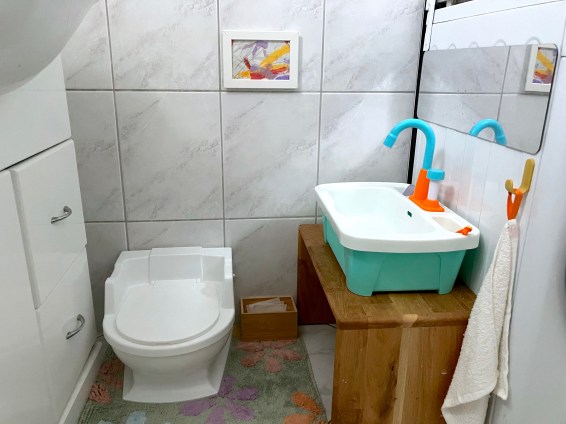
The first area we changed was in the bathroom. As discussed in the Toilet Awareness Workshop we added a simple potty, carpet, and sink to the bathroom when Jennie started walking.

Now we added a small mirror, towel hooks, wall art made by Jennie in her Montessori Baby Class, which we placed in a plastic frame. After making these changes Jennie noticed immediately and started to use this area more frequently for its intended function, rather than just exploring it.

Montessori toilet awareness, potty training, toddler bathroom, working sink

The next space was a self-care area in her bedroom. This is a small table made from a cube chair turned on its front. The mirror is stick-on plastic and non-breakable mirror. The blue container is for hair bows and is from Tiger Copenhagen. The wooden tray is from Ikea and keeps tissues for nose wiping. The wall hooks are secondhand from HM Home and the matching bags were made by hand by a friend. We use them for cream, sunglasses, hair clips and hair ties, and a brush and comb. The first day we set it up Jennie was so excited that she spent an hour exploring all these materials. She now uses this space every day. 

Montessori toddler self care area

Finally we made this little kitchen for Jennie which is still in progress. So far she uses it only for drinking water and taking her snacks, but eventually I plan to set it up for simple cooking activities and dish washing work. 

Montessori kitchen, Montessori ikea hack, toddler kitchen, functioning child sink

The kitchen is from Ikea, bought secondhand. The cutting board was custom made by Chad. The water dispenser is made of plastic and itโ€™s very easy to use. I attached it with velcro stickers so Jennie can easily push the button. I also found these lovely trays which fit perfectly, also at IKEA. The enamel trash can also comes with a cute lid, but itโ€™s too distracting and hard to open for the time-being. On the side I have attached stick-on hooks for her dustpan, broom, mini mop (from Kaufland, no link), and wash cloths. 

Finally I bought a role of adhesive foil on Amazon to add some color to the space. The mat and wall art are both from IKEA. These additions are mainly cosmetic, but making the space beautiful is inviting and attracts the childโ€™s attention. They really appreciate all the little details.

And that is all of Jennieโ€™s new practical life areas at home for the moment now that sheโ€™s a big, grown up toddler. ๐Ÿ™‚


Final Thoughts 

Since making these changes we have noticed a lot less tantrums and frustration. She is also so proud of herself when she knows where to do things and where the materials go. It was so simple and inexpensive to make these small changes for her and has made a big difference in our daily routine. 

More ways to help children during the self-affirmation crisis:

  • Activities like riding, pushing, jumping encourage their physical development. They provide opportunities for positive output of energy.
  • Offering 2 choices as often as possible helps to resolve and prevent problems without creating strife between child and parent.

    Offer two acceptable choices, for example:
    โ€œDo you want to go to the beach or to the park today?โ€
    โ€œDo you want eggs or porridge for breakfast?โ€

    This shows respect to the child because you asked for his opinion.

    2 choices also has the huge advantage of teaching reflection. The child has to consider before he answers. Starting this early helps children to be able to make bigger choices in the future. In situation when there is no possibility for choice, you must be firm and honest. Set the clear limit and enforce it consistently in a loving and respectful manner.

I hope this has been interesting and helpful!

Thank you for reading. 

– Katelynn

The Montessori Method

Montessori Sleep: FAQ

A Montessori Sleep Environment for 6+ months

In this blogpost I will be answering these frequently asked questions anonymously and I will give advice based on Montessori theory. This doesnโ€™t mean that itโ€™s the perfect solution for you, every family and every child is unique, but I will do my best to give helpful suggestions and if those suggestions feel right for you, then try them out.

Listen to the podcast:

Sleep is such a personal topic . It is a skill that all children have to learn. The relationship your child has with sleep affects the whole familyโ€™s mental and physical health so making changes regarding their sleep situation should involve the whole family. Communicate with each other so that everyone is on the same page and whatever you decide to do is the right solution for everyone, parents and children.

Question 1

My baby is 5 months old. She only falls asleep when I am cuddling with her, not my partner, just me. If I am not there she will cry 95% of the time. What should we do to help her find sleep by herself or with my partner?

  • Children can easily get used to one thing that they need to go to sleep. This can be cuddling with a specific parent, like in the example above, it can also be a pacifier, a lovey, milkโ€ฆ It doesnโ€™t mean that they canโ€™t find rest another way, they just have to re-learn how to sleep without that attachment. Believe in your child that they can do it. 
  • Their whole life they have slept one way, so changing that understanding will take some time. On top of that, they have to process this new information when they are tired and probably when the parent is tired also which makes it even more challenging. Communication, patience, and complete calm are so important in this process. 
  • Make a change that your family has decided on, go to bed early so they havenโ€™t passed exhaustion, and stick to your plan so it doesnโ€™t send mixed/negative messages. You can do this!
  • You can make a plan to take it slow. For example, start with day sleeping, then move to night sleeping. Instead of getting in the bed, sit next to it and offer comfort and closeness this way. Let the child feel all of their feelings about this process without judgement. If there are tears, let them be expressed and show compassion. This is your childโ€™s way of saying โ€œI am tired and I am having a hard time.โ€

Question 2

How should I set up a Montessori sleeping area?

  • In Montessori we use a low bed or a floor bed which is a mattress on the floor, on a carpet, or on a base which is only slightly higher than the floor. Eventually baby moves to this bed as they transition to independent sleeping. 
  • The sleep area is should be in the darkest, quietest part of the room. 
  • Make the space functional and inviting. 
  • You can keep some books nearby in a basket or on a shelf for reading before bed. There shouldnโ€™t be any noisy or highly stimulating toys in the sleeping area – this is a place of quiet where the child knows they can go if they need to find rest.
A Montessori Cestina (sleeping basket) for babies from birth to rolling

Question 3

How and when should we transition from crib sleeping to toddler bed sleeping?

  • Make this transition when you feel your child is ready and when you are ready to commit to the transition which can take some time.
  • When the child is walking they should be able to get in and out of bed independently. 
  • Step-by-step: Remove the crib and introduce the bed in the same day. You can invite your child to help you or they can observe what you are doing passively. 
  • Talk about how โ€œYour โ€˜new bedโ€™ is in this box. We are going to open it and put it in your room so you can sleep there.โ€
  • Say โ€œGoodbye!โ€ to the crib with your child so they have the memory of it being gone.
  • Put the new bed exactly where the crib was before if you can. 
  • On the first few nights, go to bed a little bit earlier and prepare yourself (what you are going to say + your positive attitude) for coming into the room several times before they fall asleep. You will have to remind them that itโ€™s time to rest, go back to bed, and tuck in every time in the exact same way. ๐Ÿ™‚
  • Keep a neutral attitude of calm and acceptance. Itโ€™s just a new bed, not an overly exciting or a bad thing. This will also help your little one accept it.

Question 4

How and when should we transition from co-sleeping to independent sleeping alone?

  • If this is what your family has decided is best for you, you can make this transition when you are ready to commit to it. It can take some time and no matter when you decide to do this, it will be a learning process for your little one. If your family is happy with co-sleeping and it works for you, then you should continue it! There is no 1 right way to sleep.
  • Explanation: Co-sleeping is family sleeping, so often itโ€™s difficult for the child to learn how to fall asleep when the family is not right by them and that they have their own bed now where they sleep alone. 
  • The first step is to get them their own bed, talk about it, show where they can put their headโ€ฆ โ€œThis is your own bed. When you are tired, you can come here and rest.โ€
  • Donโ€™t get into the bed yourself, because it is a place where only your child sleeps.
  • Start with day sleeping, sitting near the bed if they want closeness. Gradually give more and more space until they are sleeping there fairly comfortably. Use a specific routine before they get into bed to sleep. (For example, lunch, brush teeth, change clothes, read books, sing a special song, give a kiss, then itโ€™s quiet time.)
  • Begin changing the night sleeping by giving information and going to bed early. โ€œTonight you will sleep in your bed and we will sleep in our bed.โ€ Use the exact same routine as you do before a nap.
  • If they are upset, be their calm and give them the words to explain how they are feeling. โ€œYou feel tired right now and itโ€™s hard to get to sleep. I am here for you.โ€

Question 5

My baby is 13 months old and he wakes up every 2-3 hours. We are a co-sleeping family. How can we help him to have a more normal sleeping pattern? It feels like everything is on pause until we can sleep through the night.

  • The sleep cycles of a child this age should be longer than this so itโ€™s a sign that they are waking up for a reason. 
  • There are many reasons why toddlers could wake up in the night:
  • digestion – their tummy is upset or they have food in their stomach so their rest is not quality
  • they are waking for a bottle (they donโ€™t need to eat at night any more at this point, so slowly give less watered down milk until they no longer feel hungry at night.)
  • they sleep with a pacifier or lovey and itโ€™s fallen out triggering their wake-up response
  • they are feeling discomfort – teething, sickness, overheated, uncomfortable
  • they have had a bad dream
  • they have woken themselves up with their own movements or by the sleep noises and movements of the other people in the bed (If this is the case, perhaps they need their own sleeping space away from the noise and movements of others – which is OK if thatโ€™s what they need. There are no rules on where or how to sleep.)
  • I recommend saying โ€˜goodbyeโ€™ to sleep props/associations
  • Communication: Encourage independence by teaching her how to find rest without waking you up. Teach her what you do when you wake up in the night.
    – keep a waterbottle nearby the bed
    – teach her how to flip her pillow over
    – take off socks
    – roll overโ€ฆ

About using a pacifier or other sleeping props:

  • Say โ€˜goodbyeโ€™ in a respectful way. Itโ€™s a real and strong attachment your child has, so treat it with love. 
  • After 3 difficult nights, itโ€™s usually over with.
  • If they use the pacifier other than at night, start by using it not using it during the day, then for night sleep, and finally for day sleep. 
  • You can also say goodbye to the pacifier all together at once!

Question 6

My baby is 17 months old. She sleeps alone in her bedroom but the bedroom door is closed so she has to cry to call one of us when she wakes up.  How can we give freedom without creating a bad habit of leaving the room during rest time? At night, would it help if we open his door before we go to bed, so he can go out and find us when we wakes up? How about at nap time?

  • This is a good idea to open the door when itโ€™s time to wake up and let them come out when they are ready.
  • You can also try leaving the door cracked after you say โ€˜goodnightโ€™ and if they get up, remind them to itโ€™s time for sleep and going back to bed.  See question #3
  • Perhaps you can add a long extension to the door knob so they can open it alone.

Question 7

My son sometimes sleeps either naked or topless when he refuses to put his pyjamas on. I don’t force him to put on his pyjamas if he resists. Should I insist on this as part of the routine? Are there unintended consequences of me agreeing to let him sleep without pyjamas on?

  • This depends on you. If itโ€™s okay for you, then yes. If itโ€™s a limit for you, then no.  Always sleep with some protection like a diaper or training pants. In the summer itโ€™s hot and lots of people donโ€™t wear pyjamas.
  • Personally, I think itโ€™s fine – Itโ€™s the childโ€™s choice. Offer them to put on pyjamas and let them decide if they want or not. 

Question 8

My toddler wakes up at 5:30am. Why is he waking up crying?  Why so early? How to help him understand that morning starts at 7.30 and 5.30 is still night? How can we help him to wake up happy saying hello?

  • 6am is a pretty normal time to wake up in the morning for toddlers. Their best sleep usually takes place between 8pm and 6am. 
  • See question #5 for reasons why your toddler might be waking up. 
  • Waking up early could also be part of your childโ€™s bodily rhythm. If possible, prepare the environment so when he wakes up he can prepare himself a snack when he wakes up or play independently. If the environment is safe, itโ€™s okay to say, โ€œI still need to rest. You can relax here with me or you can go prepare some fruit.โ€ 
  • If possible, change your routine to go to sleep earlier and his routine to go to sleep later so you can wake up at the same time. 
A reversible Montessori floor bed (by Montessori Mother Materials)

Question 9

Why does my baby wake up every hour screaming? Itโ€™s as if he is afraid of being alone even though he is in a familiar and safe environment and has never had any traumatic experiences around sleep.

  • When a toddler passes out from exhaustion, this sleep will be more restless and involve more wake-ups at night. 
  • Waking up suddenly and crying is a natural response which comes from an instinct to react to threats of danger or being alone. The fear of being alone is a natural fear in all children . It isnโ€™t only a sign of trauma. 
  • Communication before bed โ€œI will be in my bed and come say good morning to you. โ€œ โ€œYou woke up and felt worried. I am here for you. Spend time in the bedroom for a while before and after sleep so the room is not only a place of aloneness. 
  • Always be calm and understanding, translate her emotions, meet her where sheโ€™s at, let the fear pass for her and keep going with the day. 
  • The childโ€™s emotions are very powerful in the moment, and when the moment has passed the emotion will have passed. Take a step back to observe how they are feeling, help them work through their emotions, and be their calm.

Question 10

We have a night routine and my toddler knows it very well. However, every night is a fight. Heโ€™s exhausted because he only sleeps 30 minutes to 1 hour during the day. He wakes every 2-3 hours crying or calls me for cuddles. How can I help him find rest? He is too stressed and so I am. 

  • It sounds like in this situation it becomes very had to manage because both child and parent are exhausted. 
  • Try to go to bed before reaching the point of exhaustion. Try to help them not get overstimulated during the day, which will help him relax at the end of the day. 
  • Crying is a natural form of expression and we can respond to it with 
  • Make sure that all of his sleeping situations are consistent so he can make the associations with where and how to find rest. 
  • If the tantrum every gets to much for you to handle, leave the room for a few minutes. Calm down, listen to a song or drink a cup of tea. Come back and explain โ€œI was feeling overwhelmed and I needed to have a calm moment. I feel better and I am here for you now.โ€
  • Crying is a normal and healthy form of emotional expression. Be there for your toddler as they release all their emotions. If they push you away, give them space and let them know that you are nearby if they need you. 
  • Every time he wakes up you donโ€™t need to run in straight away. Try to understand the cries and see if he needs something or is afraid. If heโ€™s just woken up and is not really upset, give him a couple of minutes to see if he can get back to sleep by himself. If not, observe how he is feeling + if he needs anything, help him work through his emotions, and be his calm. 

Question 11

How will my child manage to sleep with a caretaker (kita, tagesmutter, babysitter)? What can I do to help?

  • Make sure that both you and your child trust the other carer completely before they start putting them to sleep. If you feel comfortable with the way they are going to put them to sleep, it will help your child to feel secure. You can help them to have success by giving information about your childโ€™s sleep routine. Hopefully in day care they will not insist that the child has to fall asleep at first, but offer quiet rest time. 
  • Sleeping in this new way will become part of their normal daily group routine. Believe in your little one and trust that they can do it. 

Conclusion

At this age babies and toddlers are still not usually sleeping the same way that adults do. We would love for them to, but physically many are still developing the ability to sleep through the night. Sometimes they need help to learn how to get to sleep and how to get back to sleep when they wake up. The key is communicating with your partner, making a plan, and being consistent with your plan. Change, especially around sleep is difficult because the child is having to learn and process information while they are already tired. At first it will be hard but it will get better and you will be able to sleep through the night, at least hopefully, 80 percent of the time. ๐Ÿ™‚

All of your had work will pay off and your child will learn how to relax and sleep when they are tired, a skill which will help them their entire life.

Thank you for reading! I hope that you found this interesting and helpful. Feel free to reach out to me if you have any questions. 

-Katelynn

The Montessori Method

Gender equality in Montessori

According to numerous studies, children develop a socio-cognitive understanding of gender groups in the first 3 years of life and categorise themselves into one of those groups. (1) In this formative period, what should parents and educators do to support the childโ€™s sense of equality? What role does gender equality play in the Montessori approach to education?

background

Dr. Maria Montessori (1870-1952) was a person who challenged gender boundaries in medicine, politics, and of course, education. She was one of the first specialised female doctors in Italy, lectured internationally for womenโ€™s rights, and advocated for social reform through the Montessori approach to education.

The Montessori method is an education for life, preparing the whole individual to coexist with others in a peaceful world. For this reason Dr. Montessori knew that it was important for girls and boys to be educated together as equals. It was just as important that the boys learn the โ€œpractical lifeโ€ skills of food preparation and cleaning the floors as it was that the girls study mathematics and science. (4) 

For all of the work Dr. Montessori did for education, women, children, disabled people, and science, she was nominated for the Nobel Peace Prize three times!

gender-neutral elements of Montessori 

  • Montessori materials are available to all children at any time for them to follow their own interests and learn. 
  • The clothing children wear is chosen based on function, comfort, and protection rather than appearance or gender recognition.
  • Interactions between teacher and student are the same regardless of the childโ€™s gender. It is the work of the Montessori teacher to make their own personal transformation into a being of love and knowledge so that they can create a secure place for children to learn, absorb, experience, and explore.
  • The responsibilities given to each child to be safe and courteous to others apply to all children, regardless of their gender.
  • Colours of the furniture, materials, clothing, and environment are not directed or intended for any specific gender.
  • Books found in a Montessori classroom would not reinforce any gender norms. If possible, they will actually challenge them.
  • We respect and accept each child, including their gender identity.

social gender

As soon as the gender of a child has been assigned, their social gender is often immediately assigned too: what colour their clothes will be, what kind of toys they will have at home, and what their future hobbies, careers, and relationships may look like.  (2) How is the childโ€™s life then based in equality if so many parts of it have already been decided, sometimes before they were even born?

“Until the adults consciously face their errors and correct them, they will find themselves in a forest of insoluble problems.  And children becoming in their turn adult, will be victims of the same error, which they will transmit from generation to generation.”

โ€” DR. MARIA MONTESSORI, THE CHILD IN THE FAMILY

*Social gender is the way one expresses their gender identity. It also includes the way a society perceives gender. Finally social gender includes the way society encourages conformity to gender norms through gender roles and expectations.  

There is NO need for gendered baby clothing. 

The only general requirements for childrenโ€™s clothing are that it

  • is suitable for the climate 
  • facilitates freedom of movement
  • encourages collaboration + independence

Dressing babies in feminine or masculine clothing based on their gender assignment enforces conformity to current gender norms and subjects the child to stereotyping. In a perfect world this would not happen. Clothing and accessories for children are not supposed to be a way of preventing them from being misgendered. Babies and toddlers have no masculine or feminine traits; they are all equal. 

*note Gendered clothing for babies and toddlers, at least in the United States, was not popularised until the 1950โ€™s when pink for girls and blue for boys became a gendered colour convention. Increasingly since the 1980โ€™s babies and toddlers have been wearing outfits similar to adult clothing. 

There is NO need for gendered baby toys.

Studies show that babies and toddlers do not distinguish between stereotypically feminine or masculine objects according to their own gender, but rather are interested in the toys which are familiar to them. (3)

Over the years I have had many male and female toddler students who are interested in woodworking, dressing up, cooking, caring for younger babies, running and jumping. All the assertions by parents youโ€™ve ever heard such as, โ€œshe wonโ€™t like that because sheโ€™s a girlโ€ or โ€œhe needs to do this because heโ€™s a boyโ€ or โ€œboys/girls are soโ€ฆโ€ are unfounded and based on gender biases, stereotypes, and myths. Babies and toddlers have no masculine or feminine traits; they are all equal. 

other blogposts about Montessori materials and activities for 0-3

Thank you for reading! I hope that you found this blogpost interesting and useful.
– Katelynn

references

  1. “Children and gender identity: Supporting your childโ€: a medical article by Mayo Clinic
     https://www.mayoclinic.org/healthy-lifestyle/childrens-health/in-depth/children-and-gender-identity/art-20266811#:~:text=Most%20children%20typically%20develop%20the,gender%20by%20age%203%20years.
  2. โ€œUnderstanding Genderโ€: a medical article by gender spectrum
     https://genderspectrum.org/articles/understanding-gender
  3. โ€œEarly androgens, activity levels and toy choices of children in the second year of lifeโ€: a psychology article by Texas A&M University
    https://www.researchgate.net/publication/230810604_Early_androgens_activity_levels_and_toy_choices_of_children_in_the_second_year_of_life
  4. โ€œDr. Maria Montessori, Feministโ€: a blogpost from The New Inquiry
    https://thenewinquiry.com/blog/dr-maria-montessori-feminist/
Classroom Tours, Montessori Materials, The Montessori Method

Practical life in the Montessori Toddler Community

montessori toddler classroom, wooden staircase, art area, montessori table and chairs, toddler environment, infant community, shelfie, berlin montessori school
photo by Natalia Smirnova

WHAT IS PRACTICAL LIFE?

Practical life work is the cornerstone of Montessori from 0 to 3. Caring for the environment and self-care is the greatest goal of the walking toddler. Now that they can carry themselves upright like adults, they want to achieve total functional independence. Their school can offer rich opportunities to reach functional independence because the entire classroom should be prepared to suit their needs. At school the teacher is observing them constantly and can change the environment for them. This means offering concrete practical experiences by which children can do purposeful work and have success in doing so. This is the work which will open the door to responsibility and self-awareness, and link the child to the world.

The activities are called ‘Exercises in Practical life’ because real everyday life is carried on in which all housework is entrusted to the little ones who execute, with devotion and accuracy, their domestic duties becoming singularly calm and dignified.”

โ€” Dr. Maria Montessori. The Discovery of the Child. Ch. 3.

Das Kind Magazine

For the full version of this article (translated in German!) and other Montessori inspiration by the Deutsche Montessori Gesellschaft, you can sign up for biannual issues of “Das Kind” magazine for โ‚ฌ20 a year.

PRACTICAL LIFE FOR NORMALISATION

In Montessori we refer to โ€œnormalisationโ€ as the integration of intellect and movement. Especially for children who struggle to find peace and balance, through practical life they find opportunities to create order, repeat movements, explore the senses through manipulation, move freely, and imitate adults.

Movement is the secret for holding the attention of the child.”

โ€” Dr. Maria Montessori, Creative Development in the Child I

Activities in practical life have a cycle of preparing the work, concentrating on the process, and satisfied rest once the work is complete.

GUIDELINES FOR PRACTICAL LIFE

  • Organise activities in the appropriate areas.
    Water materials should be near the water source; tooth brushing should be in the bathroom; and so onโ€ฆ
  • Each activity has its own place in the environment.
  • Every activity is complete.
    The presentation of the material should be logical so that the child can follow the use of the material easily. Have extra materials available in case something needs to be replaced.
  • The characteristics of the materials should be appropriate for the child.
    Weight, size, fragility, and other factors must be considered.
  • Make the materials beautiful.
  • Colour code the materials.
    Most of the materials should be matching. This is for the sake of beautiful presentation and to remind the child which materials go together. If an activity is not colour coded it does not need to be excluded from the environment.
  • Use points of interest.
  • Points of interest encourage the use and repetition of materials. This may include sensorial experiences such as making bubbles, fogging a mirror, or anything that is exciting and interesting for the child.
  • Only keep a limited number of materials.
    There are few materials of which we have many. For example, you may have several cutting knives so multiple children can cut together in the kitchen area. However, in principle there should be only one of each exercise. This teaches the child to wait for his turn and respect the work of others.
  • Check the activities often.
    Prepare the environment before the children arrive and constantly over the course of the day. Check every exercise to make sure that everything is clean and ready to use. If you find an abandoned mess, invite a child to help you. If no children clean up with you, clean it yourself with precision, in case a child might be observing you. If you donโ€™t have time to clean at that moment, take the material out of the environment and finish cleaning it later.
  • Practice your presentation until it is done normally and beautifully before you present it to the children.
  • Observe the child and make changes you observe help them to have success.

HOW TO PRESENT PRACTICAL LIFE MATERIALS

  1. Invite the child.
    Approach the child and model how to get someoneโ€™s attention respectfully. Give an enthusiastic invitation which is not a question, nor a command.
  2. Go together with the child.
    Keep the childโ€™s pace. You may offer your hand to the child and the child may accept it or not.
  3. Involve the child.
    During the first presentation, do only the first half of the work and let the child finish it.
  4. Analysis of movement
    Observe your own movements: how fast they are, how you stand, if you are blocking the childโ€™s visionโ€ฆ
  5. Language
    Give the child the names for things before presenting. This is done by isolating the noun or verb and avoiding moving while speaking. โ€œspongeโ€
  6. Be aware of your body posture.
    When you bend over, bend the knees and lean forward slightly. Remain standing. Donโ€™t squat or kneel less the child could also squat or kneel.
  7. Wear aprons
    The adult and the child both put on an apron when the activity calls for it.
  8. Let the child take over the work.
    When the child shows they want to take over some work, let them take it over. As soon as a child loses their concentration on a new task, you should be nearby and ready to get involved. Sometimes letting child hold something or fetch something for you is enough to let them feel involved.
  9. Clean up.
    As soon as you see a working child has lost concentration, you should get involved and give the clean-up presentation. Always encourage the child to clean up independently. If need be, you can go back over spills or fix small things in the material later. Children often forget or donโ€™t clean up and need to be reminded to do it. This doesnโ€™t mean that they donโ€™t enjoy cleaning.

a photo tour of the practical life in our classroom

– WELCOME TO MONTESSORI CLASS! –

montessori dressing area, frames, ikea hack, shoe shelf, shoe brushing, spice rack, book display, frame display, toddler shoes, cube chair, selfcare, nienhuis, berlin montessori school
photo by Natalia Smirnova
  • Get ready!
    The first thing toddlers do when they come into class is sit down, take off their shoes, put them in a โ€œspecial place on the shelfโ€, hang up their jackets, and put on their indoor slippers. They feel so proud as they put their things away and get to work.
  • Cleaning shoes
    If they are very interested in shoes, there are also two shoe brushes fastened to the side of the shoe shelf where they can clean all their friendsโ€™ shoes and even the parentsโ€™ if they like.
montessori toddler sink ikea hack, watter source, child sink, montessori bathroom, practical life, hand washing work
photo by Chad Chittenden
  • Washing hands

Having a low source of running water is by far the greatest resource I feel that the environment offers toddlers. As soon as they are standing, they can stand in fascination for minutes letting the tiny stream of water fall over their fingertips and turning the spout on and off. The sink satisfies the sensitive period for water and gives the child access to all the water-based practical life activities. It allows them to explore and โ€œplayโ€ with water, while having the responsibility and focus of purposeful work.

montessori potty, toilet awareness, potty awareness, elimination communication, prepared environment, montessori toilet
  • Toilet Awareness

    In the bathroom there is this beautifully and simply prepared area for potty learning where little ones can practically explore their interest in the potty and learn how to use it Montessori-style.

– WORKING IN THE KITCHEN –

orange juice toddler making orange juice montessori practical life, food zone ikea cups, bed bath and beyond mini orange juicer, montessori snack, functional independence, montessori kita school in berlin
toddler cutting a bamama using a joie crinckle cutter toddler knife in the prepared kitchen area of montessori mother learning center in berlin, germany. This encourages funtional independence and the child can prepare food for himself whenever he feels hungry
photos by Kerly Ilves

  • Get a drink

When toddlers feel thirsty, they can go to the kitchen area and take a cup and pour themselves some water from a pitcher which comes out of a dispenser or prepare themselves fresh orange juice made from toddler-sized mandarins.

  • Prepare a snack

When the feel hungry they can go to the kitchen and prepare a snack for themselves. I always put out 2 food preparation activities at the childโ€™s level, one group snack preparation activity (at my level to bring down and do with the children), orange juice squeezing work, and the water dispenser with just a minimal amount of water inside. As my trainer Patricia Wallner would say, โ€œNever put out more water than you are willing to mop up.โ€  ๐Ÿ™‚ Food preparation activities include cutting bananas, cucumbers, or strawberries, peeling pears, peeling mandarins or hard-boiled eggs, plucking grapes, cracking peanuts, and spreading cream cheese on crackers.

This dishwashing station is one of the montessori practical life tables which we diy made from an ikea bathroom shelf hack, muender email enamel, and montessori design by nuccia polka dot toddler apron. Toddlers wash their own dishes when they want to in the montessori infant community or playgroup and have fun playing with water in a purposeful work way.
  • Washing the dishes

Sometimes after eating or drinking a toddler may want to wash their dish or those of their classmates. I also put out 2 โ€œdirtyโ€ metal plates each class with just a little bit of coffee grounds on top to give the opportunity to make a distinct dirty-then-clean connection.

beautiful montessori dish washing presentation with child-sized materials and muener email white enamel basins a dish brush and mini bottle of soapy water
photo by Karen Ong

PRESENTATION:
The child fills the basins with water, squeezes/shakes in some liquid soap (90% water, 10% baby-safe dish soap). They carefully choose which single dish they would like to wash. Often, they enjoy using it to transfer water between basins โ€“ a beautiful discovery. After they have finished washing the dish, they set it to dry on the rack and pour out the basins into the bucket. They bring the bucket to their low sink and dump it out. After replacing the materials, they mop up any spills with a mop for the floor or a towel for anywhere else.


– CARE OF THE ENVIRONMENT –

Taking care of their environment is a toddlerโ€™s favourite activity because it is their way of connecting and having an impact on the world around them.

our montessori cleaning area is beautifulluy color coded in blue to support the montessori sensitive period for order in children and toddlers from twelve months to six years. this area includes mopping child mop and adult mop from obi in berlin, a table washing cart handmade by montessorimmaterials in berlin with muender email enamel so toddlers can care of the environment in berlin's first montessori playgroup, sweeping toddler proom and dustpan, and wall photo duster for toddlers and babies to clean all hanging from string loops off wall hooks to support order at the child's level
photo by Chad Chittenden
  •  Washing the table

Presentation: When you or the child notice that a table is dirty, invite them to wash it. The child fills the pitcher of water and pours it into the basin. Replace the pitcher in the basket. Wheel the cart to the table which they would like to wash. Wet the brush and soap and rub the bar of soap into the brush. Show the child how to scrub the table and let them try. After the table is scrubbed replace the brush and take the sponge. Slowly wet the sponge and squeeze it out โ€“ invite the child to try. The child wipes the table. Show the child where to put the sponge. Use the mitt to dry the table. Invite the child to clean another table. When they are finished, dump the water from the basin to the bucket. Carry the bucket to dump it out. Replace the bucket. Push the cart back to its place.

*This cart was made by hand with love by Montessori Mother Materials*

  • Mopping
    The toddlerโ€™s fascination with mopping is truly beautiful. Once the floor was wet, and now itโ€™s dry! One of the first signs I see when a baby is becoming a toddler, is that they start mopping! In the toddler class, the mop is almost constantly in use because toddlers often spill drops of water when they do practical life and are eager to mop up every drop.  
  • Sweeping

Itโ€™s quite difficult for toddlers to sweep something up and dump it into the trash. They love concentrating on this work and doing their best. I also have a small vacuum they can use to clean up messes if they spill sand or soil.

  • Dusting

Recently I added the duster to our cleaning area for dusting the walls and picture frames. Because brooms and mops can only be used on the floors, I found that the toddlers also needed something to clean the walls with and this was important to many of them. As Montessori guides we must observe the childโ€™s needs and adapt the environment to meet them where they are at.

using an aquarium in the toddler classroom or montessori kita toddlers love to feed the fish in this quiet cozy reading zen corner of the environment which is very meditative, small, sunny, and beautiful. It also supports a love and respect for life nature while encouraging gentleness and calm around smaller living things.
photo by Kerly Ilves
  • Feeding the fish
    Feeding the fish teaches respect for other life. It is also so relaxing to watch the fish swim around and can help the toddlers find calm.
Montessori cloth washing station with a polkadot apron by montessori design by nuccia and drying rack red enamel in the prepared montessori toddler community environment
photo by Karen Ong
  • Washing cloths
    Cloth washing is one of the most advanced practical life activities for toddlers who really need to exercise their concentration and do work involving lots of movement and multiple steps of varying difficulty.
montessori toddler sink filling up red polka dot pitcher made from enamel for the practical life cloth washing table station the sink is in the prepared montessori bathroom with mini sink from ikea
  • AGE: from 2 years
    PRESENTATION:
  • Invite the child to put on an apron with you. Ask them to choose which cloth from the bucket they would like to wash. Put the cloth in the left basin. Invite the child to fill the pitcher and carry it to the basin. Fill the first basin and go back for more water to fill the second. After soaking the cloth with water, demonstrate how to lather the cloth with the soap bar and scrub it. Wring out the cloth and hang it on the clothesline. Both of you take a clothespin and secure the cloth. Invite the child to wash another cloth by themselves. When they are finished washing or lose concentration, begin the cleanup process. Put the bucket on the floor. Each of you pour a basin of water into the bucket. Let the child carry the bucket of water to the sink and empty it. Replace the bucket and use the mitt to dry the basins and table. Mop up any spills. Hang up the apron.
montessori window washing small mini spray bottle from nienhuis special toddler sized water work practical life in the montessori parent child community playgroup in berlin germany
photo by Natalia Smirnova
  • Washing windows
    This is material is a very popular material on the shelf. Toddlers love to go all around the school and spray the windows, glass doors, mirrors, and aquarium with this tiny spray bottle and watch the water slowly run down. They use a squeegee and a small towel mitt to wipe up the water. Older toddlers like to bring a step stool so they can clean even higher. It is one of the best materials for very active toddlers because it offers movement, water, and clear before + after results.

– SHARING CULTURE WITH TODDLERS –

The child has the potential to incarnate any human characteristic, language, religious/spiritual connection, and culture. Here are two practical life activities for sharing culture with toddlers.

montessori wooden stair art hanging work choosing the photo art to hang on the wall in the montessori toddler community environment in my montessori parent child playgroup in berlin
photo by Natalia Smirnova
  • Hanging art

This material allows the child to choose which art they would like to hang on the wall. In the basket there are various famous paintings, photographs and drawings by famous artists like Van Gough and Renoir.

culture practical life activity decorating a holiday christmas tree with toddlers
  • Decorating a holiday tree

    Over the holidays the toddlers really enjoyed decorating this real tree with baby-safe ornaments and bead strings.

– CARING FOR PLANTS –

montessori sweeping watering can green garden work on wall hooks prepared in the montessori care of the outdoor environment in nature farm to table little ikea wall shelf
toddler watering the flowers barefoot in child garden in montessori school in berlin germany
  • Working in the garden

In the garden the toddlers really enjoy watering the flowerbeds, planting seeds, sweeping the deck, blowing bubbles, jumping on the trampoline, exploring the sandbox, and collecting the herbs and strawberries they grew.  

plants in the child's room classroom in montessori caring for nature, basket of balls, white monhtessori shelf, cube shelf, plant watering work purple mini ikea watering can, flower arranging, practical life, tulips
  • Flower arranging
    In this sunny corner toddlers can water their plants and arrange fresh flowers into tiny vases. These flower arrangements adorn our table during the group snack time. Usually one toddler arranges all three and carefully places them side by side on the table with lace doilies underneath.
  • Plant watering work for babies
    Itโ€™s such a special experience when children are discovering plants, how to care for them, and thus how to respect other living things.

    AGE: standing/12 months
    PRESENTATION:
    The first time I present this to a child I fill the watering can myself and invite them to watch me water the plant. I slowly pour half the water into the soil, using two hands. Then I set it down and invite the child to try. They will water the plant or possibly spill on the floor or try to drink the water. This is okay because they are learning! Use the sponge or towel to wipe up the spill. Invite the child to re-fill the pitcher of water. If the child is still not walking confidently, I fill the pitcher again for them with a very small amount of water from another pitcher which I keep at my level.

– LIFE SKILLS –

  • Self-Care

Toddlers love themselves deeply. In their self-care area children have access to several activities such as brushing + combing hair, wiping their nose with a tissue and tossing it in the waste basket, applying face cream (baby lotion), and trying on hats and sunglasses.

toddler beading sewing activity life skills practical life shelf work, montessori materials, wooden beads, sewing activity
photo by Natalia Smirnova
  • Sewing
    In our classroom an entire shelf is dedicated to threading and sewing activities arranged from the simplest to most challenging. Eventually the toddlers can embroider with a yarn needle โ€“ work which they tape off and get to take home with them.
montessori woodworking station by ikea with a light and small todler tools so children can use wood and tools, saw, drill, hammer, nails, screwing, srewdriver, bamboo broom and dustpan, ikea pegboard and stool, made by montessori mother materials, the only montessori playgroup toddler classroom in germany montessori kita school in berlin
montessori woodworking station toddler sawing using a saw with soft balsa wood, cutting wood safely with asaw, montessori moments
photo and materials by
Chad Chittenden
(Montessori Mother Materials)
  • Woodworking station
    Woodworking is a very special area of pride in our school. Humans have the natural tendency to use tools to do their work. Not surprisingly the presentations for these materials are very short, because toddlers as young as 12 months can use them intuitively.

    IN PRACTICE:
    Each tool has its own pre-prepared block which fits into the table insert. This keeps the block stable, isolates the difficulty of the tool, and supports the sensitive period for order. Toddlers love to sit at this station and go through all the tools which are arranged from least to most difficult, bottom to top, right to left. The presentations are hammering nails, wearing goggles, unscrewing screws, cutting soft balsa wood strips with a saw, sanding, and drilling holes. There is a small broom and dustpan available for sweeping up sawdust.

– GROUP WORK –

group practical life, community toddler snack time and washing the table wiping with sponges and small mini toddler-sized water spray bottle
adorable toddler with visor at montessori class in berlin's only montessori playgroup
toddler baking day making banana muffins with ikea aprons working together as a group mini muffin trays and banana mashing
tea brewing work for toddlers garden farm to table mint and lavender tea for toddlers to make for themself and their friends
  • Group snack
    After the toddler work cycle one or two toddlers volunteer to prepare the snack and dishes for everyone. They push the food and plates to in a cart over to the table and sit down together. I invite each child individually to join us at the table where they may serve themselves or each other food and water.
  • Wiping the table
    After snack the toddlers can help clean up by wiping the table with sponges and water, putting their dirty dishes back on the cart and bringing the cart to the kitchen. Usually the interested toddlers do this for the rest of the group.
  • Baking days
    In addition to preparing snack for each other, once per month we have a baking day when we make muffins or cookies and enjoy them together at the end of class.
  • Brewing tea
    AGE: from 2.5 years, or when the child uses scissors
    Brewing tea using the mint and lavender leaves from our garden is the closest experience available in my school to a farm-to-table experience. They carefully brew the tea for their friends and enjoy it together at the table.

– SAY “GOODBYE” –

After a long morning of hard work, we gather together and sing songs. Then we say โ€˜goodbyeโ€™ before toddlers and carers get ready to go home.

montessori dressing area toddler wardrobe montessori practical life shelf, work carpet, montessori mother and parent and child
photo by Natalia Smirnova

Thank you for joining me on this practical life tour through the Montessori Toddler Class! I hope you found it useful and interesting.


You can learn more about our school HERE > About Montessori Mother ELC

You can order Montessori furniture + materials HERE > Montessori Mother Materials

Photographers:
Natalia Smirnova
Kerly Ilves
Chad Chittenden
Karen Ong

The Montessori Method

Montessori Mixed Age Groups: in school & with siblings at home

toddlers doing practical life work in montessori class

at home

Tips on the Montessori home environment for siblings

  • arrange the environment or play space so that both children can use it at the same time (for example, a movement mat for baby and a table and chair for your older child can be near each other so that they can learn from each other through observation)
  • instead of buying multiple versions of the same thing, teach siblings that if a material is in use, it’s unavailable. It it is not in use, it is available to either sibling
  • if one sibling wants something the other is using, teach them to trade for a reasonable alternative instead of just taking it
  • organise the shelf so that the materials on the lower part are intended for younger siblings, and materials on the top of the shelf are intended for the older siblings
  • keep any small parts in containers which only the older child can open. This is a safety precaution that allows your 3+ child to satisfy their need to work with tiny items and keeps your under 2 child safe
siblings without rivalry montessori book recommendation

Book Recommendation: “Siblings without Rivalry” by Adele Faber

in school

For a school to be considered Montessori, each class must have mixed age groups. Maria Montessori stressed the importance at least a 3 year age difference in a class (3-6, 6-9, and 9-12 years). In 0-3 we separate the classes from 2-16 months and 16 months to 3 years because the big changes the child goes through in the first years of life require differently prepared the environments.

toddler doing coinbox material work at montessori table in class

why a mixed age group is the best way to support learning and growth

1. each child is in one area the teacher and in another, the learner

Mixed-age groups are the ideal platform for learning responsible behaviour and mutual respect. Everyone is at some point the smallest or the largest, sometimes the strong or the weak, the person seeking help, or the helper. In Montessori young children grow up caring for each other and nurturing their self-esteem, self-confidence, and respect and empathy for others.

In Montessori children can strengthen their knowledge by demonstrating or communicating it to others. Younger also seem to be most at ease when surrounded by older children and enjoy learning from them by observing them with silent fascination.

2. every child has room to grow at their own pace

Having all the materials within the age group available at the childโ€™s level, allows them to advance onto the next challenge when they are ready. It also makes it possible for them to follow their interest and advance in their strongest areas, while still being able to enjoy learning in others which are more challenging. Because teachers do not have to set the instruction pace by a whole group, each child is given the ability to learn at his or her own pace in every aspect of their development. 

3. it allows for cooperation over comparison

When there is an age difference, older and younger children are able to work together to achieve a goal and solve problems. When every child is expected to be at the same stage in their development, it opens the door for competition. No longer do we see each childโ€™s individual skills and abilities, we see which child can do the same thing better and faster.  Children will help each other when cleaning up after work, putting things away, caring for the environment, and caring for each other. 

toddler choosing wall art in montessori class

the big picture

This relationship of mutual care and respect, of self awareness, and awareness of the strengths and weaknesses of others make Montessori mixed-age classrooms the ideal place for learning peaceful conflict resolution.

The Montessori approach is an Education for Peace and mixed age groups is its cornerstone.

– all photos by Natalia Smirnova

The Montessori Method

Montessori Food Q+A

Montessori weaning in the parent-infant class
Snack time in the Montessori Baby Class where babies enjoy food together and parents learn about Montessori-style weaning.

This blog post is common question and answer style discussion about Montessori Weaning, food-related difficulties with toddlers, play food, and links to a great Montessori mealtime set. I hope you find it very practical and helpful! 

1 | Montessori Weaning

โ€œHow does Montessori weaning work?โ€

Montessori weaning is a child-led approach to the transition from milk to solid foods. We use real, child-sized dishes, glasses, and cutlery to make their experience similar to they way they see us eat. A great place to introduce Babyโ€™s first food is at the family table during a family meal. After you start introducing solid foods, your baby will decide how fast or slow you change to eating food all the time. Start a meal with the food you have chosen, and finish the meal with milk. Gradually baby will take more solid food and less milk until they are completely weaned.

โ€œWhen should we introduce solid foods?โ€

In Montessori we follow the childโ€™s interest and natural path of development. Babyโ€™s interest in food sparks around 6 months old. They will start to reach for food at the table, to watch with fascination while you are eating. They have probably had their first tooth and they will be sitting comfortably with support. This is a great time to start introducing new flavours and drinking water from an open glass.

โ€œWhat are some good 1st foods?โ€

What you give as your babyโ€™s first food is up to you, your culture, and their interest. You can give juices, broths, soft solid vegetables, soft fruits, purees, or tastes of what you are eating during family meals.

babies eating bread and strawberries at Montessori weaning table
These babies have the choice between strawberries and soft bread.

2 | Refusing food

โ€œMy child just isnโ€™t interested in food!โ€

There are multiple reasons why children refuse foods. Sometimes they donโ€™t feel hungry; sometimes they are too tired/overstimulated/not feeling well and will prefer milk. Having scheduled mealtimes also makes a big difference because your child can feel when itโ€™s time to eat based on your daily routine and prepare themselves.

Starting each meal/snack time with 2 solid food options allows the child to choose which food they want to eat and how much. You can finish each meal with milk to make sure that they get all the nutrition that they need. If they have refused a food, have patience, stay positive, and keep offering different options. If you are concerned about how much your child is eating, please speak with your paediatrician.

toddler eats at Montessori table
A toddler enjoying strawberries during snack time, which he cut for himself in Montessori Toddler Class.

3 | Family Meals

โ€œMy child doesnโ€™t want to sit at the table.โ€

First you should set the general expectation that when we eat, we eat at the table. If they are hungry, I promise that they will sit with you and eat. When they are done and they want to leave the table, put the food away together. Do not to continue to feed them or give snacks while they walk around. This is distracting and it sends the mixed message that food comes to them and they can eat it wherever they like. Remember to have patience and stay positive. ๐Ÿ™‚ You are the parent and you are setting a kind, but firm limit.

“My toddler wants me to play with him during meal times.โ€

Family meals give babies a lot of information and language. They should be able to participate as an equal member of the family by having a place for themselves at the table – to join you in eating or just observing. If they want to go play after they have finished eating, thatโ€™s fine, but you also need to finish your mealtime. You can let your little one know that after you have finished and cleaned up you will be happy to play with him, but at the moment itโ€™s meal time so they are welcome to sit with you at the table or play in their space until you are able to join them.

Our adjustable weaning table by Community Playthings and handmade cube chairs

4 | Throwing food

โ€œWhat should I do when my child throws food?โ€

If you are trying to feed your child and they are throwing food, maybe they are not hungry enough to eat right now or they have finished their food. If they have finished eating, they we should set the example that throwing food isnโ€™t appropriate by removing the food and cleaning up together. If they are not hungry, you can try again to sit down an eat in 30 minutes.  Make sure to give at least two options with meals so they can decide which food they want to eat.

Snack table in our Montessori Toddler Class

5 | Using real food + dishes

โ€œWhy donโ€™t you use toy food in Montessori?โ€

In Montessori we always give real objects so that children can have their own experiences and learn about real life. Toddlers are fascinated by cooking and eating, something that they have observed adults doing for their whole lives and they are even more interested when they have the opportunity to do it themselves. So instead of a wooden banana with velcro, give them a real banana and a dull knife (link below) and they can cut it themselves and prepare their own snack!

How great is it that when they feel hungry they can know where to go and what to do to feed themselves. As long as you prepare a space for them in the kitchen where they can do this easily and safely, they wonโ€™t have to ask an adult each time they feel a bit peckish. They can meet their own need until the family mealtime. You can start doing this with simple snacks as soon as your little one is walking-around 16 months. Just empty out a low cabinet or shelf and put there a little try or box with one favourite snack in it that they are allowed to take and eat at any time. It helps if they have their own little table nearby where they can sit, prepare, and enjoy it as well.

โ€œWhy do you give real glasses and plates to babies?โ€

We always use real cups, dishes, and cutlery with our babies and toddlers in Montessori. Using plastic spoons and dishes and water bottles is not necessary. We should trust the child enough to  allow them the same pleasant experience we expect when eat. 

6 | A Montessori Mealtime Set

Montessori Materials, The Montessori Method

How to set up a Montessori play area at home (from birth to 3 years)

What are the reasons for using Montessori education at home?

1.Our absolute main goal is to support the childโ€™s mental and physical development. First we are aware of what the childโ€™s needs are, and then we prepare the space for them, so that they can follow their natural path of development with everything in their environment is available to them to use to meet each developmental need. 

2. Understanding the child also makes parenting them more peaceful and more joyous because it takes away our struggles and frustration of every-day tasks like getting dressed, going off to sleep, etc 

3. At home, you are often able to allow your child to have more control over their learning than they have at school. When children have more control over their learning, they are able to face challenges, grow their creativity, and become more resilient. They have to be self-aware, resourceful, and confident in their capabilities in order to solve their own problems. 

4. Finally, Montessori is an education for life and gives children a love for learning so that they can succeed in every other area of their life. 

Parts of the Montessori 0-3 Environment

When we talk about the home environment from 0-3, we are looking at 4 general zones of the childโ€™s space. They are the sleep, care, food, and movement areas. In this blogpost, we are going  to focus mostly on the movement area because thatโ€™s usually what people think about when we talk about Montessori and the other areas can be different for every family.

The toddler (5m-walking) play area includes…

ยท low, light-weight table and chairsprovides a comfortable place where the child can focus on their work
ยท cleaning suppliesteaches responsibility and allows child to do practical life work
ยท toddler shelf with 6-10 materials organises the toddler’s materials for most success
ยท easelprovides a comfortable place for artistic expression
ยท access to water sourceallows the toddler basic access to drinking water and water for practical life (just a small amount)
ยท plant with watering canteaches how to care for nature
ยท 3-8 books on a low Montessori bookshelf or basketchild can grow a love for reading
ยท wall art hung at eye levelbeautifies the space + gives visual information
ยท reading loungegives the child a comfortable place to enjoy their books

The baby (5m-walking) play area includes…

ยท larger movement mat or regular carpetallows Baby to move freely, easily, and safely
ยท mirror on the wall with pull-up barprovides motivations and opportunities to stand
ยท low shelf with 6-8 materials organises Baby’s materials for maximum success
ยท push wagonallows Baby to walk independently and practice balance
ยท tactile mobilestrains the grasp and supports concentration
ยท plant with small watering pitcherteaches how to care for nature
ยท 3 books on a low Montessori bookshelf or basketchild can grow a love for reading
ยท wall art hung near to floorbeautifies the space + gives visual information
ยท place to climbstairs, a Pikler triangle, or bridge offer a defined climbing area

The newborn (0-5m) play area includes…

ยท firm movement matallows Baby to move freely, easily, and safely
ยท low horizontal mirrorgives visual feedback on movements; allows Baby to see more of the environment
ยท low shelf with 3-6 materials or booksprovides motivation to crawl
ยท visual mobilesgives gentle stimulation and supports visual development
Montikids $60 off code: MONTESSORIMOTHER60
ยท plantshares an appreciation for life and nature
ยท wall art hung near to floorbeautifies the space + gives visual information

I hope you found this helpful and interesting! I will go more into detail about materials and other zones of the environment in separate blogposts.

The Montessori Method

Understanding your Child’s Temperament

montessori toddler parent playgroup mother nesting activities

What is temperament?

The childโ€™s temperament is the social and emotional part of their personality, which they are born with. Understanding our childrenโ€™s temperaments and the way it contrasts with our own can help make life easier so that we can:

>>> prevent and manage problems more easily
>>> modify the childโ€™s environment to best suit their needs
>>> set reasonable limits & expectations

There are no bad or good temperaments, only constructive or non-constructive expectations towards them. 

We can be a positive model of temperament control by accepting the childโ€™s natural tendencies and adjusting our reactions through self-observation.

Try to avoid giving the children labels like, โ€œshe is fearless; he is socialโ€ฆโ€ because it can be difficult later to free them from this role. This temperament questionnaire is simply meant to help us to recognise their patters of behaviour so we can maintain a peaceful and positive connection with our little ones. ๐Ÿ™‚

Use the questionnaire below to compare your temperament and your child’s. Do you have similar or differing personalities?

Montessori Temperament Questionnaire

1. Activity level

temperament qualities Montessori tips
HIGH – rarely bored
– enjoys playing independently moves
– constantly seeks out new things
– wiggles and needs to move around
– makes decisions impulsively (or perhaps recklessly)
– needs frequent breaks from sitting
– Try to anticipate whatโ€™s going to happen throughout the day and plan several steps ahead.
– Allow enough time to burn off energy
– Give activities one at a time, particularly when traveling.
– Find new skills and challenges or materials to keep them interested and engaged in the environment .
LOW – generally calm and easy-going
– content to sit quietly for long periods of time
– often found engrossed in a task
– sits through mealtimes
– Let them play and figure things out at their own pace (donโ€™t interrupt or rush them).
– Allow enough time for the child to transition to a new task.
– Accept that they will take their time doing things. 

2. Adaptability

temperament qualities Montessori tips
HIGH – can easily cope with unexpected situations or events
– easily influenced by the feedback from others
– Be a positive model of behaviour and language. They are absorbing everything. ๐Ÿ™‚
– Give positive feedback instead of general praise: “You put the puzzle together! You look very pleased with yourself!”
– Give plenty of opportunities for new challenges.
LOW – takes time to warm up to new situations or places
– does not enjoy switching from one task to another
– changes in the daily routine may be upsetting
– Aim for a routine whenever possible. 
– Prepare your child in advance if thereโ€™s likely to be a change.
– Allow them to repeat as much as they need to whenever possible.
– Invite them to try something new, but respect their choice if they decline.

3. Approach to new situations & sociability

temperament qualities Montessori tips
BOLD – has a carefree, fearless approach to life
– enthusiastic about new situations and people
– doesn’t consider possible dangers
– Let them have their own experiences, but monitor closely for safety
– Give frequent reminders
– Set clear boundaries
HESITANT – less likely to put self at risk
– exhibits caution
– hesitates often and for long periods of time
– Prepare for new situations and experiences ahead of time
– Donโ€™t force them to participate if they are not comfortable

4. Attention span

temperament qualities Montessori tips
SHORT – eager to move on to the next thing
– most work is not done to completion
– doesnโ€™t follow long demonstrations
– gets great satisfaction from completing tasks
– forgets to tidy up
– Keep language and instructions to the minimum
– Allow them to get involved quickly
– Use points of interest to help them notice what they are doing.
– Remind them what they were doing if they get distracted
– Have a place fore everything and a clear order to the space
– Encourage practical life activities
LONG – without distractions, can concentrate for a long time
– persists even when facing difficulty
– can return to an activity even if their attention has been briefly redirected
– does activities to completion
– gets great satisfaction from completing tasks
– Allow the child to  continue or repeat a task as long as they need.
– If you need the child to do something or go somewhere, wait until their state of concentration has ended.
– When you see that the interest and intensity of their concentration is fading, invite them to tidy up or try something new.
– Respond to tantrums with gentleness and compassion.
– Introduce activities that require multiple steps .

5. Distractibility

temperament qualities Montessori tips
HIGH – notices every sound and movement
– doesnโ€™t maintain a constant  state of concentration, but can come back to their current task (if attention span is long)
– finds it very difficult to become fully engaged in a task (if attention span is short)
– Provide a quiet and orderly workspace to limit distractions
– Remind them what their work was if they get sidetracked
– Never interrupt  if they have achieved focus
LOW – can remain focused, even amidst chaos
– becomes frustrated if something isnโ€™t working perfectly
– Allow them to go through a process at their own pace.
– Show them slowly and clearly each new activity so they can have success
montessori toddler playdough clay work art materials mother

6. Intensity of Reaction

temperament qualities Montessori tips
HIGH – must have all needs met at all times
– very self-aware
– demands attention
– attracted to what other children have
– Have patience
– Model mindfulness and respect
– Remind them of other people and children in the environment
โ€œAlfieโ€™s working on that. It will be available soon.โ€
– Set kind a firm limits.
LOW – laid-back
– enjoys most things
– doesnโ€™t react when their work is taken away
– Try to give them the language to express their wants or needs
โ€œDo you want to say, โ€˜this is my work. It will be available soon?โ€ 
– Look for signs of their desires which they may not be expressing
– Offer 2 choices so they can practice choosing for themselves and self-awareness

7. Mood

temperament qualities Montessori tips
CHEERY – smiley
– seems to have fun in most situations
– Observe closely because the child may have developmental needs or obstacles that may be overlooked. 
SOMBER – difficult to read
– complains often
– Accept the child for who they are.
– Make sure they know their feelings are being heard
– Invite to try something new or try a new way

8. Rhythmicity

temperament qualities Montessori tips
HIGH – naturally falls into routines for eating, sleeping, and toiletting
needs and behaviour are predictable 
behaviour can become erratic with the daily routine is changed if the child has a high reactivity
– Try to anticipate changes and have an appropriate alternative available
“Your boots are unavailable right now. Would you like to wear your boots or your sneakers?”
– Make changes one at a time, for example reading one new story before bed or one new flavour at snack time. 
– Give 2 choices and for opportunities to try something new, but respect their choice if they say no.
“Would you like to go to the pond or the playground today?”
LOW – can ‘go with the flow’
– is not upset by changes in the routine
– it’s difficult to predict their needs without a clearly established routine
– Respect that the child’s patterns may vary from day to day. Some nights they need sleep more than other nights. Some days they need to be more active than other days. 
– Incorporate a regular routine, but allow the child to have some control. For example, make the same quantity of food available at mealtimes, but let the child control how much they eat. 

9. Threshold of sensitivity

temperament qualities Montessori tips
HIGH – sensitive to the feelings of others
– may react negatively to sudden noises or movements
– may exhibit compassion and try to soothe others
– Allow them to feel and express their feelings in an appropriate way
– Give language to express that they are understood and language to understand the outside person or situation.
“Are you feeling concerned? You noticed that Yuna was crying. Let’s go see if she’s alright.”
“That was a loud noise! Did it startle you?”
LOW – seems not to notice the feelings of other people
– might notice others’ reactions but not realise that they can affect or cause them
– Be a positive model of awareness and sensitivity
– Try to give them the language to understand how others may be feeling.
“Let’s ask if Luka would like a cuddle before we give him one. Luca, would you like a cuddle?”
“Stomping is loud and disturbs others. Let’s go outside and stomp.”

10. Cuddliness & soothability

temperament qualities Montessori tips
HIGH – feels relaxed when you hug them
– can be soothed by cuddles and words of reassurance
– Offer a cuddle when they are upset before picking them up. “Would you like me to hold you?” Allow them to express yes or no. 
LOW – feels more comfortable at arms length
– just needs time to relax after being upset rather than cuddles or caresses
– If they push you away, don’t take it personally. Stay nearby and let them know you are there for them without giving a hug. 
– Offer a cuddle and allow them to express yes or no. 

Photos by Chad Chittenden and  Kerly Ilves at Montessori Mother ELC