Blog

The Montessori Method

Understanding your Child’s Temperament

montessori toddler parent playgroup mother nesting activities

What is temperament?

The childโ€™s temperament is the social and emotional part of their personality, which they are born with. Understanding our childrenโ€™s temperaments and the way it contrasts with our own can help make life easier so that we can:

>>> prevent and manage problems more easily
>>> modify the childโ€™s environment to best suit their needs
>>> set reasonable limits & expectations

There are no bad or good temperaments, only constructive or non-constructive expectations towards them. 

We can be a positive model of temperament control by accepting the childโ€™s natural tendencies and adjusting our reactions through self-observation.

Try to avoid giving the children labels like, โ€œshe is fearless; he is socialโ€ฆโ€ because it can be difficult later to free them from this role. This temperament questionnaire is simply meant to help us to recognise their patters of behaviour so we can maintain a peaceful and positive connection with our little ones. ๐Ÿ™‚

Use the questionnaire below to compare your temperament and your child’s. Do you have similar or differing personalities?

Montessori Temperament Questionnaire

1. Activity level

temperament qualities Montessori tips
HIGH – rarely bored
– enjoys playing independently moves
– constantly seeks out new things
– wiggles and needs to move around
– makes decisions impulsively (or perhaps recklessly)
– needs frequent breaks from sitting
– Try to anticipate whatโ€™s going to happen throughout the day and plan several steps ahead.
– Allow enough time to burn off energy
– Give activities one at a time, particularly when traveling.
– Find new skills and challenges or materials to keep them interested and engaged in the environment .
LOW – generally calm and easy-going
– content to sit quietly for long periods of time
– often found engrossed in a task
– sits through mealtimes
– Let them play and figure things out at their own pace (donโ€™t interrupt or rush them).
– Allow enough time for the child to transition to a new task.
– Accept that they will take their time doing things. 

2. Adaptability

temperament qualities Montessori tips
HIGH – can easily cope with unexpected situations or events
– easily influenced by the feedback from others
– Be a positive model of behaviour and language. They are absorbing everything. ๐Ÿ™‚
– Give positive feedback instead of general praise: “You put the puzzle together! You look very pleased with yourself!”
– Give plenty of opportunities for new challenges.
LOW – takes time to warm up to new situations or places
– does not enjoy switching from one task to another
– changes in the daily routine may be upsetting
– Aim for a routine whenever possible. 
– Prepare your child in advance if thereโ€™s likely to be a change.
– Allow them to repeat as much as they need to whenever possible.
– Invite them to try something new, but respect their choice if they decline.

3. Approach to new situations & sociability

temperament qualities Montessori tips
BOLD – has a carefree, fearless approach to life
– enthusiastic about new situations and people
– doesn’t consider possible dangers
– Let them have their own experiences, but monitor closely for safety
– Give frequent reminders
– Set clear boundaries
HESITANT – less likely to put self at risk
– exhibits caution
– hesitates often and for long periods of time
– Prepare for new situations and experiences ahead of time
– Donโ€™t force them to participate if they are not comfortable

4. Attention span

temperament qualities Montessori tips
SHORT – eager to move on to the next thing
– most work is not done to completion
– doesnโ€™t follow long demonstrations
– gets great satisfaction from completing tasks
– forgets to tidy up
– Keep language and instructions to the minimum
– Allow them to get involved quickly
– Use points of interest to help them notice what they are doing.
– Remind them what they were doing if they get distracted
– Have a place fore everything and a clear order to the space
– Encourage practical life activities
LONG – without distractions, can concentrate for a long time
– persists even when facing difficulty
– can return to an activity even if their attention has been briefly redirected
– does activities to completion
– gets great satisfaction from completing tasks
– Allow the child to  continue or repeat a task as long as they need.
– If you need the child to do something or go somewhere, wait until their state of concentration has ended.
– When you see that the interest and intensity of their concentration is fading, invite them to tidy up or try something new.
– Respond to tantrums with gentleness and compassion.
– Introduce activities that require multiple steps .

5. Distractibility

temperament qualities Montessori tips
HIGH – notices every sound and movement
– doesnโ€™t maintain a constant  state of concentration, but can come back to their current task (if attention span is long)
– finds it very difficult to become fully engaged in a task (if attention span is short)
– Provide a quiet and orderly workspace to limit distractions
– Remind them what their work was if they get sidetracked
– Never interrupt  if they have achieved focus
LOW – can remain focused, even amidst chaos
– becomes frustrated if something isnโ€™t working perfectly
– Allow them to go through a process at their own pace.
– Show them slowly and clearly each new activity so they can have success
montessori toddler playdough clay work art materials mother

6. Intensity of Reaction

temperament qualities Montessori tips
HIGH – must have all needs met at all times
– very self-aware
– demands attention
– attracted to what other children have
– Have patience
– Model mindfulness and respect
– Remind them of other people and children in the environment
โ€œAlfieโ€™s working on that. It will be available soon.โ€
– Set kind a firm limits.
LOW – laid-back
– enjoys most things
– doesnโ€™t react when their work is taken away
– Try to give them the language to express their wants or needs
โ€œDo you want to say, โ€˜this is my work. It will be available soon?โ€ 
– Look for signs of their desires which they may not be expressing
– Offer 2 choices so they can practice choosing for themselves and self-awareness

7. Mood

temperament qualities Montessori tips
CHEERY – smiley
– seems to have fun in most situations
– Observe closely because the child may have developmental needs or obstacles that may be overlooked. 
SOMBER – difficult to read
– complains often
– Accept the child for who they are.
– Make sure they know their feelings are being heard
– Invite to try something new or try a new way

8. Rhythmicity

temperament qualities Montessori tips
HIGH – naturally falls into routines for eating, sleeping, and toiletting
needs and behaviour are predictable 
behaviour can become erratic with the daily routine is changed if the child has a high reactivity
– Try to anticipate changes and have an appropriate alternative available
“Your boots are unavailable right now. Would you like to wear your boots or your sneakers?”
– Make changes one at a time, for example reading one new story before bed or one new flavour at snack time. 
– Give 2 choices and for opportunities to try something new, but respect their choice if they say no.
“Would you like to go to the pond or the playground today?”
LOW – can ‘go with the flow’
– is not upset by changes in the routine
– it’s difficult to predict their needs without a clearly established routine
– Respect that the child’s patterns may vary from day to day. Some nights they need sleep more than other nights. Some days they need to be more active than other days. 
– Incorporate a regular routine, but allow the child to have some control. For example, make the same quantity of food available at mealtimes, but let the child control how much they eat. 

9. Threshold of sensitivity

temperament qualities Montessori tips
HIGH – sensitive to the feelings of others
– may react negatively to sudden noises or movements
– may exhibit compassion and try to soothe others
– Allow them to feel and express their feelings in an appropriate way
– Give language to express that they are understood and language to understand the outside person or situation.
“Are you feeling concerned? You noticed that Yuna was crying. Let’s go see if she’s alright.”
“That was a loud noise! Did it startle you?”
LOW – seems not to notice the feelings of other people
– might notice others’ reactions but not realise that they can affect or cause them
– Be a positive model of awareness and sensitivity
– Try to give them the language to understand how others may be feeling.
“Let’s ask if Luka would like a cuddle before we give him one. Luca, would you like a cuddle?”
“Stomping is loud and disturbs others. Let’s go outside and stomp.”

10. Cuddliness & soothability

temperament qualities Montessori tips
HIGH – feels relaxed when you hug them
– can be soothed by cuddles and words of reassurance
– Offer a cuddle when they are upset before picking them up. “Would you like me to hold you?” Allow them to express yes or no. 
LOW – feels more comfortable at arms length
– just needs time to relax after being upset rather than cuddles or caresses
– If they push you away, don’t take it personally. Stay nearby and let them know you are there for them without giving a hug. 
– Offer a cuddle and allow them to express yes or no. 

Photos by Chad Chittenden and  Kerly Ilves at Montessori Mother ELC

Montessori Materials, The Montessori Method

Supporting Concentration in Montessori

father reading to daughter a montessori book for babies about baby bears in a parent and child class

A special part of the Montessori classroom, which is different from traditional classrooms, is that children concentrate deeply and for long periods of time on their work, whether a teacher is watching over them or not. 

Even Dr. Montessori was surprised by this when she first observed a 3 year old student engrossed in her work with the wooden cylinders in the first Casa dei Bambini  in San Lorenzo, 1917. She said, โ€œthe expression on the childโ€™s face was one of such concentrated attention that is seemed to me an extraordinary manifestationโ€. (The Advanced Montessori Method, 1965) This level of concentration later appeared in another child and another until every child in the Casa was able to reach a state of peaceful focus through their work. Thus concentration became a core principle of the time-tested Montessori method.

Montessori supports concentration in 3 ways:

  1. by offering a prepared environment (a space that facilitates the childโ€™s ability to use engage with it)
  2. by preparing interesting materials with varying levels of difficulty (practical activities and materials which engage the senses)
  3. by removing obstacles that might disrupt or distract the children.
montessori diy toddler art shelf with low table painting hanging work and ikea hack easel create activities on trays for young children in berlin

To prepare an environment which supports the childโ€™s power of concentration, the parent becomes a protector of their attention and an observer of their work. The adult must be able to differentiate between purposeful play, and chaotic play. 

Maria Montessori called the childโ€™s purposeful play with materials โ€œthe childโ€™s workโ€ because when they play, children can be deeply involved in the activity; their attention is clear and focused; and they are persistently mastering a new skill. โ€œUsed in this way,โ€ Maria Montessori says, โ€œ the material reveals itself as a key which puts the child in communication with himself and opens his mind to expression and activity.โ€ (The Discovery of the Child, p. 210)

The way young children think

toddler coin box playing at montessori shelf with wooden tray and other learning materials

Children from 0-3 have a special kind of learning style – an “inner teacher ” which attracts them to the experiences and materials which will teach them what they need to learn in the moment. Toddlers also have the tendency to ignore activities which are too simple or too challenging for them.

This tendency can be observed even in newborn babies – when they are interested in something, they will focus on it for long periods of time and when they become bored, they will look away and their period of concentration will have finished. 

Research in developmental psychology has shown that young children, when free to choose among different materials, will choose materials that optimise their development and that are just above their currently level of competence. (Lillard, p. 117)

In my classroom, the materials on the shelves are arranged from easiest to hardest, from left to right. When parents are in the class, they can see clearly that the youngest children in the group choose more often activities on the left, which are perfect for their stage of development and the older children usually choose to work with the most complicated materials on the left side of the shelf, which offer them the right amount of challenge for their stage of development.

It is because of these observations that we know we can trust the child to make good decisions and know that when we observe them in an intense state of concentration that their activity is crucial to their development and self-mastery. For this reason, we do not interrupt the child unless it is a matter of safety or consideration for others.

Supporting concentration in babies

newborn baby montessori shelf wooden toys teethers black and white takene puzzle kicking ball movement area with mirror and mat and simple wooden shelf

newborns

When a newborn is concentrating on something, donโ€™t disturb them until they are finished. You can observe them for signs: 
– When they are concentrated, they will focus their eyes on something and appear to be in a trance with it.
– When they are not concentrated they will move, maybe fuss and make noise that they are done and would like to be moved or have another need that needs to be met.

freedom of movement

Babies are fascinated with using their senses to understand the world around them better. They are also very focused on learning to slither, crawl, stand, and walk. Offering sensorial activities and open space where they can move freely is the best thing you can do to support their concentration.

Allowing the possibility of movement through an entire room opens up a whole world of interest an opportunities for the child to thoughtfully choose the activities which are necessary for their development.

baby reading a book about baby bears montessori freedom of movement concentration

Materials for supporting concentration at home

1. Levels of difficulty

The optimal materials for supporting concentration in toddlers are ones that are just above their current level of abilities, but not so challenging that they will not have success. When toddlers are under-challenged they can become deviant so itโ€™s important that their environment constantly offer them new levels of difficulty as they grow. 

For example, when you buy or prepare an activity for your child at home, think – โ€œHow will this grow with my child?โ€ Is it something you can simplify and add on to as they grow? 

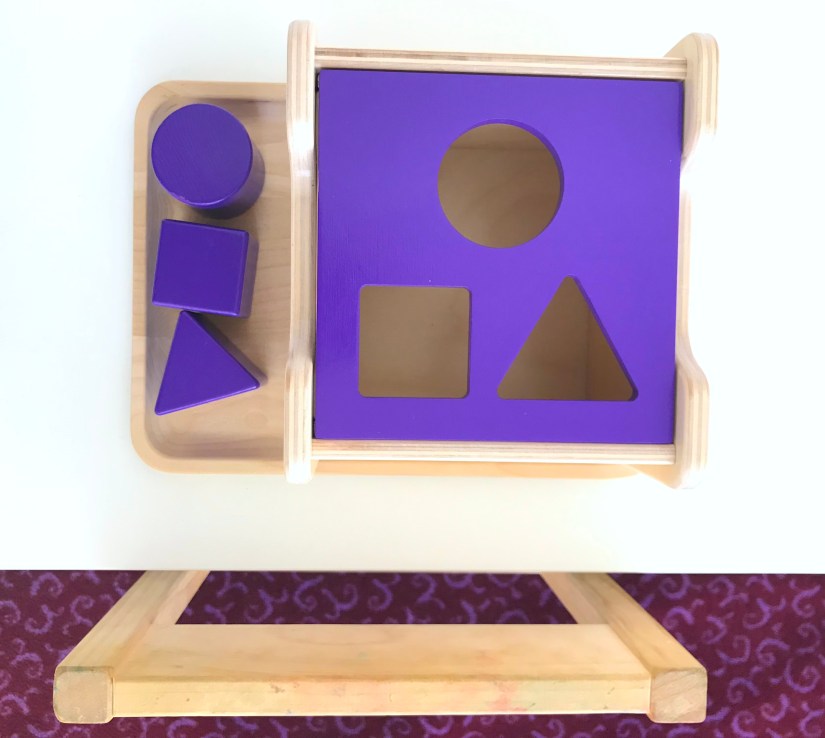
The MontiKids Mailbox, which I have in my classroom, is a great example because it teaches toddlers about early geometric concepts and new vocabulary like โ€œtriangular prism!โ€; and it comes with 3 geometric solids and 5 lids that progress in complexity. 

Montikids mailbox level 5 five montessori material for toddlers puzzle box
You can use my promo code MONTESSORIMOTHER60 to get $50 off your first MontiKids order! 

2. Practical life activities

Activities in practical life support toddlersโ€™ development of concentration more than any other Montessori materials because they fix their attention on a repetitive movement or process. The purpose of this process is focused on a goal to which the child can relate – a goal that corresponds to their need to care for the environment and engage in the activities they see adults doing around them.

Movement is the secret for holding the attention of the child.โ€

maria Montessori, Creative Development in the Child I
toddler use nienhuis spray bottle to wipe wash montessori table by community playthings

A toddler might, for example, work very hard to clean a table and then start all over again, just for the pleasure of repeating and perfecting the skill of washing it. Although materials like table-washing have a practical purpose of getting the table clean, to the child it is much more. The child is getting to imitate an activity they see adults perform regularly and they are feeling the reward of engaging their full attention on a process they can understand and complete independently. 

In Montessori we adapt all regular chores for the children so they can enjoy completing them successfully. For example, you might buy a sponge at the supermarket and cut it twice to make 3 small sponges which are the perfect size for tiny toddler hands. 

Practical tips for supporting concentration

montessori art shelf toddler concentrating at low ikea table sticker material
  • Use a shelf On a shelf in the childโ€™s play space, set up a shelf with only 6-10 activities for the child. Keep activities on the shelf which you see them repeating again and again. When they ignore an activity it may be too challenging or too simple and itโ€™s time to change the level of difficulty by adding or removing a step or exchanging it for another material.
    >>> See my blogpost on How to use a Montessori shelf at home for more shelf tips for 0-3 year olds <<<
  • Have a defined work space where the child can bring their activity. For babies this is probably a carpet on the floor in front of the shelf; for toddlers, this is a low table and chair near the shelf. Make sure this workspace stays clean and ready to use so that the child is able to focus on completing the activity they chose completely and have success in the end. 
  • Provide many opportunities for practical life (cooking, cleaning, self care). More than anything else, toddlers love to concentrate on these activities.
  • Avoid interrupting their state of concentration. Interrupting can take many forms, some as well-intentioned as giving a kiss or applauding them. Remind yourself to stay silent when they are focused on their work and give them the space they need to concentrate and learn.
  • Invite them to repeat an activity after they have finished it once. Every time they finish something, you can say โ€œletโ€™s try this againโ€ or โ€œwould you like to do this again?โ€ or โ€œyou can do this by yourself nowโ€. This gives them the chance to use the material by themselves and find concentration in the activity if itโ€™s important for their stage of development.
  • Less is more the more difficult it is for the child to find concentration, the simpler and quieter their environment should be so as to not distract or overstimulate them. The order of the space should be clear and consistent so the child can find security in the space and relax enough to find peace and focus. 

Tips for when the child struggles to find concentration

montessori magnetab magnetic doodle concentrating at an ikea table
  • Observe without intervention how the child interacts with the space. What is distracting them or drawing their attention from place to place?
  • Practical life for toddlers: entice them to get involved with some practical activity. Practical life activities are usually the first place a child who has trouble focusing will find concentration. 
  • Let them find their own solutions to their problems. Often with a child who has trouble concentrating, trying to help them will immediately cause them to abandon their activity and move on to something else. Their point of interest is often the difficulty itself, rather than the task. 
  • Lower the noise level in the space. When the space and the people around him are peaceful, the child will be more aware of themselves and their surroundings. Itโ€™s very easy for babies to become overstimulated and for toddlers to become overwhelmed. 
  • Don’t cause distractions: When they finally concentrate on something, say nothing and do nothing, so as to not distract their attention. 
  • Do your own purposeful work: Model concentration yourself by focusing completely on one thing at a time like reading a book, doing some handwork, preparing a meal.

References

Lillard, Angeline Stoll, Montessori: The Science Behind the Genius, 3rd Ed., Oxford University Press, 2017
Montessori, Maria. Creative Development in the Child 1. Kalakshetra Press, 1994
Montessori, Maria. The Discovery of the Child, Third Edition,1948
Montessori, Maria. The Advanced Montessori Method, 1965

Photos by Kerly Ilves Photography , MontiKids, and Montessori Mother ELC

Classroom Tours

Baking with Toddlers

I baked with toddlers every day for a week and here is everything I learned!

How did you use Montessori to bake with a group of toddlers ?

  • colour matching
  • trays of activities/isolation of difficulty
  • the children could join in or leave at any point/allowed the children to follow their own interests 
  • it was age inclusive, children from 15m to 4yrs participated together
  • we had a big cleanup session afterwards that was enjoyed by the children as much as the baking.
learning through observation

How keen were the toddlers on baking?

During the first hour of the class I invited the toddlers to cook with me at our group table and we started peeling pre-cut pieces of bananas. Some groups were more interested than others. Having a group activity was something we hadnโ€™t done before and I many toddlers decided to continue with their normal class day, as if to say, โ€œNo thanks. I have work to do. See you at snack time!โ€  The children who attended multiple baking days were generally more interested and aware of what we were doing, of course.

It was fun to make sure that each child involved in the process had a task to do that they were interested in. Some preferred wiping up the table and floor, some were very involved in the cooking process, while others preferred to observe or eat batter with a spoon. Some loved pouring in ingredients, but didnโ€™t want to smash the bananas. All the toddlers got to eat their muffins together before the end of class, even if they didnโ€™t help make them. This way every child got to be part of the group. The children were very generous and sweet sharing with each other.

What do you want to do differently next time?

I wish I would have included more language and vocabulary. On the last day a parent was going over the ingredients with two toddlers as they ate their muffins and I realised I could have done the whole workshop as a 3 period lesson: giving vocabulary, letting them explore each texture, taste, and smell, and then give demonstrative instructions of what we do with each ingredient.

What is the BEST thing about baking with toddlers?

Giving the children the opportunity to see the whole process of where their food comes fromโ€” from bananas and flour into a muffin. To go even a step deeper, with 3-6 year olds, you could ground dried oats to make your own oat flour. It’s really easy.

Working together on a group project was also interesting. Itโ€™s not something that happens very often with more than two or three students at a time. 

Step-by-Step:

Step 1: peeling, chopping, mashing

Step 2: pouring, transferring, mixing

Step 3: sorting, scooping

Step 4: sponging, sweeping, drying

Vegan mini-Banana Muffin Recipe

Ingredients (makes 3 dozen mini muffins)

  • 2 cups gluten-free oat flour
  • 2 teaspoons baking powder
  • 1 tablespoon cinnamon
  • 1/2 teaspoon baking soda
  • 1.5 bananas
  • 1 cup soy milk
  • 1/2 cup organic maple syrup
  • 2 mini muffin trays
  • mini paper muffin forms
  1. Mix dry ingredients in a bowl
  2. Mash or puree banana in a separate bowl with milk and maple syrup. 
  3. Stir in dry ingredients
  4. Spoon batter into paper muffin forms in the baking sheet
  5. Heat oven to 200โ„ƒ
  6. Bake muffins for 10-15 minutes
  7. Ready when the sides are golden brown. Remove from baking tray and let cool in a separate basket.
  8. Let the toddlers enjoy and offer each other muffins!

>> recipe tips when baking with toddlers <<<

  • Start off with twice as many bananas as you need to make it into the batter. The toddlers will probably first like to sample them and make sure they are tasty enough. 
  • Mix all the dry ingredients together yourself and then give them the mixture. They can use a spoon to transfer it into the bowl of liquid ingredients.
  • Measure out the milk and syrup in advance and pour into 2 separate pitchers
  • The muffins will turn out fine even if the ingredients donโ€™t all make it into the bowl, and even if the batter isnโ€™t evenly spooned into the forms. I promise. ๐Ÿ™‚ 
  • Flour on a hard-wood floor is a great sweeping opportunity for toddlers. They LOVE it!

Thank you for reading! I hope this was helpful. Comment if you have any recipe ideas for Baking with Toddlers Pt. 2!

Montessori Materials, The Montessori Method

The Way Children Play: how to use a Montessori shelf at home

what makes Montessori toys special?

Montessori toys are not built to entertain the child, but rather to engage their curiosity, creativity, and problem solving skills.

Children love to learn. They are naturally curious and fascinated by the world around them. They are eager to perfect their own skills and mimic the things they see older children and adults doing. They “play” to absorb new information and to train their skills. They enjoy repeating over and over these new skills until they have been perfected.

A child who is confident in their surroundings and their ability to approach the things that intrigue them is one who learns actively from their environment.

independence & perseverance

Montessori fosters independence and self-direction through the thoughtful design of each toy, through the layout of the play space, and through the way the adult interacts with the child. When children have more control over their learning, they work harder, perform better, retain more information, and are more creative and joyful. 

Children learn most when presented with just the right amount of challenge, not so easy that they are bored and not so difficult that they are frustrated. The Montessori curriculum is thoughtfully designed and timed so that children are repeatedly entering this ideal zone for learning.

Montessori maps a childโ€™s development so that with each toy, the child goes through the experience of struggling with a new skill, practicing and then mastering it. Mastering challenging activities helps children to develop healthy self-esteem and the self-awareness that they can improve their abilities and increase their intelligence. Children with this independent mindset also persevere longer on challenging tasks, a valuable life skill.

how are Montessori toys different from commercial toys?

Montessori shelf for a child 12-16 months old
  • Montessori toys are designed to meet the childโ€™s developmental stages.
  • They provide just the right amount of challenge, without being over stimulating.
  • They isolate the difficulty of learning one new concept at a time . This allows the child to challenge themselves without getting overwhelmed.
  • Montessori toys help children to self-correct. This encourages your child to repeat and gain the tremendous benefits of solving a problem independently.

how to use a Montessori shelf at home

Montessori shelf for a child 20-24 months old

The goal of the Montessori shelf is not to fill children with information but rather, to provide a rich environment and support their natural drive to learn through play.

rotate, guide & observe

  1. Add 6 toys to the shelf
  2. Allow them to play with the toys on a carpet or low table next to the shelf
  3. Rotate toys according to their interest:
    If they donโ€™t use one of the toys on the shelf, it might be too easy or too difficult for the child and should be altered or rotated out
  4. Show them how to use a new toy when you add it to the shelf, then let them use it independently from then on

which toys should I buy?

less is more

 You probably already have a lot of toys for your little one. Before buying anything, go through what you have and choose 6 good toys to start off with and the rest can be stored away for later. 

levels of difficulty

The best toys for at home are ones that will grow with your child, offering multiple levels of difficulty. I have included a table with 6 examples below to demonstrate what this means. 

level one | 12-16 months

Montessori Puzzle Box
$50 off promo code >>>

Ring on a rocking base

Pegboard with 4 kinds of wood

Box of containers
similar suitcase available on Amazon

Bead Threading
trays from Absorbent Minds

Russian Nesting Doll

level two | 20 – 24 months

from MontiKids – Level 5
MONTESSORIMOTHER

similar toy by Ancona

handmade by Mamumabird

find containers around the house your child enjoys, clean them, & add them to their box

DIY IKEA Hack – Mula
more IKEA hacks from my classroom here

different styles available on Etsy

Thank you for reading! I hope this blogpost has been useful for your family’ s Montessori journey. Feel free contact me if you have any questions!

The Montessori Method

Translating for Toddlers

The interpreter is to the child a great hope, someone who will open to him the path of discovery when the world had already closed its doors. This helper is taken into the closest relationship, a relationship that is more than affection because help is given, not merely consolation.โ€

Maria Montessori. The Absorbent Mind. 1949

Listen to the podcast:

Understanding their position

Compare yourself to living in a country where you do not speak the language. Many of us can relate to the frustrations the child could feel when… 

  • things happen to them which are not explained
  • instructions are given hurriedly without being shown
  • being treated by speaking people as if disabled because you cannot speak the language
  • wanting to say something important but you donโ€™t have the words

Understanding their reactions

In these situations I may not have much self-control; I may become agitated, enraged, and begin to cry. That is what happens the child of one or two years old who has tantrums. They are intelligent and know people could understand their ideas, but cannot express them through lack of language. This is a dramatic epoch in the life of the child. (Maria Montessori, The Absorbent Mind)

Do not misinterpret the child expressing their frustration as deviant behaviour. They are facing a great struggle and feel comfortable enough with you to let you know how they feel and ask you for your help to calm down. Imagine how misunderstood they must feel!

One word sentences

Around 1.5 years old, toddlers realise that every object has a name. They use one noun to express a whole idea. Letโ€™s call this form of self-expression one word sentences. These words are also often abbreviated or altered. When we respond to these sentencesโ€™ translations, we give the child reassurance that they are being understood and we bring them calm.

Thank you for reading! Let me know if you have any comments or questions!

Classroom Tours

Montessori Ikea Hacks

toddler aquarium reading nook montessori

part 1 of 3

Preparing a Montessori space for toddlers may take some extra time and planning, but it doesn’t have to be complex or expensive! In this blogpost I have explained the Ikea hacks I used when preparing 5 different areas of my classroom, along with links and lots of photos.

1.Easel

This easel allows the toddler to explore their own artistic creativity. I find that toddlers are interested in painting almost as soon as they can walk from around 14/16 months old! Of course it’s important to use washable paint (like the ones sold by Ikea) and have a washrag or little mop nearby to clean up any messes. ๐Ÿ™‚

Instructions | I used a hacksaw to cut the legs by 17cm and sanded the edges.
I also dded a plastic hook to the side from which to hang the child’s apron. Clips hold pre-cut pieces of paper from the top of the easel. A bucket to the side holds extra pieces of paper. I have also added some art to the wall at the child’s level to beautify the space.

2.Table and Chairs

montessori toddler work table

These tables can be used in the play area for concentrating on activity or in the kitchen as a snack table. I have also seen them used as sensory tables and dollhouse tables. Toddlers LOVE having their own place to sit and work or eat. It’s something so simple, yet so important for them.

Instructions | Shorten the table so that it stands at a comfortable height for toddlers (38cm). Also shorten the chairs by 7cm. It’s slightly time-consuming, but very doable to make these with a simple hand saw and some sand paper-and it’s very worth it!

3.Self Care Area

toddler self care area vanity montessori

The self care area is a place where toddlers can go to brush their teeth, comb their hair, wipe their nose, put on sunscreen, etc..

Instructions | At home you might add a self care area to the bathroom or changing area to support independence and collaboration. I also added some hats and a basket of sunglasses for the children to try on. Notice that the chair is the same as the one from the toddler table in IKEA hack #2.

4.Reading Nook (relaxation corner)

reading nook montessori quiet corner zen area for toddlers

This is a quiet area in my classroom where toddlers and babies can go to read, watch the aquarium, play music, and relax.

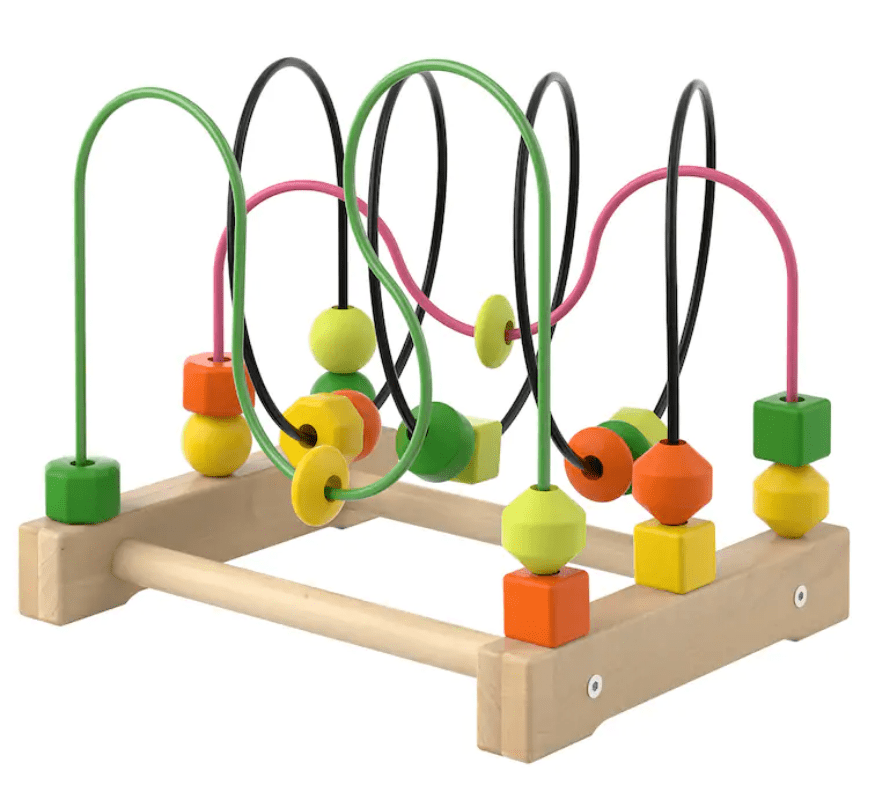
Instructions | I made this new cover and pillow to make the chair more inviting and beautiful. Also the Ikea chair cover is not washable (be careful!). While assembling the bead tracker, I added only one bead to each track in order to give the activity a clearer purpose: transferring beads from one side to the other. The extra beads are perfect for a threading material.

5. Newborn Movement Area

montessori newborn movement area
with mirror and mobiles

From DAY 1 we can start to offer freedom of movement. This movement area is a place where non-walking babies from 0-6 months can observe their movements and the world around them through the mirror. Visual mobiles hang within Baby’s range of sight and move naturally with the air in the room.

Instructions | Mount the mirror to the wall for safety. You can also secure the back with duct tape if the mirror is made from glass rather than acrylic glass. Attach the hanger to the wall and use a string to tie the mobile and adjust its height. On the mattress you can also put a fitted sheet for easy cleaning.


Thank you for reading! I hope you found this post interesting and helpful! I plan to make 2 more of these posts soon. Feel free to leave a comment or suggestion below if there is something more you would like me to include next time!

~ Katelynn

The Montessori Method

Imagination and Creativity in Montessori

Listen to the Podcast:

โ€œHumans have a tendency to imagine, to create and to invent with the intellect. For example, an act of imagination allowed humans to use animal fur and plant fibres to construct clothing. A child in the classroom imagines a new constructive way to use a material or how the globe represents the earth.โ€

Angeline Stoll Lillard
(2017, The Science Behind the Genius: 3rd edition, Oxford University Press, p. 120)

There is a common misconception that the Montessori approach doesnโ€™t encourage children to be imaginative and creative. This simply isnโ€™t true. It is true that under 3 years old, we focus on the real world around the child to support the development of imagination and creativity, rather than encouraging fantasy. In this blogpost and corresponding podcast, I would like to discuss the following: imaginary play, fairytales, and creativity through art and music.

1. Imaginary Play

Around 2.5 + years , we will then see our child begin with pretend play. This is a sign of them processing what they see around them, not fantasy. They play families, bake us cookies, and pretend to be the school teacher.

simone davies (2018, The montessori toddler, p.94)

In a true Montessori classroom, you wonโ€™t see a pretend play-kitchen or a costume dress up corner. Instead you could find a real, child-sized kitchen area where children can prepare food for themselves or each other; a self care area; a cleaning area the toddlers can use to tidy any messes that are made during class; and a large art area where the babies and toddlers can express themselves creatively. In my school there is also a special woodworking area where the toddlers can safely use real tools to see a real cause and effect.

For Montessori at home, the adult involves the child in day-to-day activities like cooking and dressing and washing. There is no need to give toys that only represent real life (like wooden foods or a plastic toy appliances) when they are fully capable of having real-life experiences with those day-to-day activities that they find so fascinating.

At home you might also put out some open-ended toys from 2.5-3 years old. These allow for many possibilities to let their imaginations grow, without prescribing exactly how they should be used. For example, a set of blocks can be built in any way to represent anything to the child.

2. Fairy Tales

While they are allegedly intended for children, fairy tales are often very scary and not based in reality. Children under 3 and even up to 6 years old have difficulty distinguishing fantasy from reality. Everything we tell them is very real and very true to them. They trust the information that we give them entirely.

Thatโ€™s why in Montessori the books we read to children under 3 and the stories we tell them all give true information to the children and have realistic depictions of the story. Hopefully toddlers’ books offer information they can relate to their own experiences so they can consider them more deeply and learn more about that topic through the book we are reading to them.

Linguistically when children are able to understand figurative speech like metaphors and symbolism, they very much enjoy fairytales and mythological stories that require critical thinking. Among other things in regards to literature, the Montessori approach aims to give children a strong base in reality from the beginning, so that they can learn to understand complex stories and figurative elements.

3. Creativity Through Art and Music

Art and music are a large part of Montessori education. Maria Montessori believed arts to be just as important as other subjects. There should be a sizeable art area in the Montessori classroom with many different creative, and open-ended activities the child can use whenever they are inspired to do so.

Music is another important part of Montessori education. Musical instruments are available at the childโ€™s level to support musical expression. In every Montessori class we sing and dance and enjoy music together with the children.

In the art area of the Montessori classroom, children have the freedom to explore new possibilities that make them wonder what else could they do? How else can they try?

In Montessori it is our goal that children have an environment which encourages curiosity through the freedom we give to the child and the ways that we prepare the space so that children become curious about the world around them and develop the ability to think and create for themselves.

โ€œThe secret of success [in education] is found to lie in the right use of imagination in awakening interest, and the stimulation of seeds of interest already sown.โ€

โ€” Maria Montessori
(1948, To educate the human potential. Madras, India: Kalakshetra)
Uncategorized

What Your Child Is Capable Of : from birth to 18m

Listen to the podcast:

Maria Montessori spoke extensively on the great potential of the child. She explains the amazing ability children have to absorb everything they experience in the first years of their life. She also wrote about the Sensitive Periods they go through, which highlight each childโ€™s perfect moment for mastering a skill- from great feats like walking and speaking to achievements in independence such as potty learning or self-dressing. 

The chart I have made follows the sensitive periods for movement and language from birth to 18 months old.  It is a month-by-month guide, sharing some of the things children do during these months and a few Montessori activities which are appropriate during each stage of development. 

However it is important to remember that every child has their own perfect timing to learn to turn, crawl, walk, and talk.  As always in Montessori, our purpose is to follow the child

When we are aware of all the things our little ones can do, it makes it possible for us to truly trust them and give them the space they need to grow and the opportunities they need to apply their full potential.  

So what can we do to help our babies?

We know that Babies and Toddlers are happiest when they have a stimulating environment that challenges them, but doesnโ€™t overwhelm them, which offers understanding, and allows them to have success and also feel joy from their accomplishments.

1. We can offer a safe space for them to learn and discover.

newborn movement area at home

~ for newborns and small babies we set up a movement mat on the floor and a low mirror which allow them to see and feel their unrestricted movements, clearly.

~ when they start crawling and walking we clear the floor for them so they have enough space to move around. If possible we prepare a whole room or part of a room which is completely safe to let them explore freely.

The key to this is trusting your child and also trusting that the space you have prepared for them is truly, completely safe. 

2. We can provide activities that help Baby learn and perfect new skills.

advanced rings of graduating size on a stable base (2 years old)

I will give one example for the newborn, baby, and toddler stages:

~ newborns train their eyesight with Montessori visual mobiles
At birth babies can only see high contrast and they canโ€™t change their focus. Mobiles like the Munari , which are black and white and move naturally with the air in the room, are slow enough for them to follow and see clearly. 

~ A couple of months later babies are improving their grasp and release with ring on dowel activities of increasing difficulty.
They start with one large ring on a stable base around 6 months old and eventually work up to several small rings of graduating size in a basket next to a stable or rocking base around 14 months old.

~ and walking toddlers grow their independence through practical activities like washing hands and slicing bananas.
They are very interested in taking care of themselves and taking care of their environment so we set up activities for dressing for self feeding, food preparation, cleaning, caring for plants, and lots of other exciting opportunities so that they can have success in these daily tasks which are so fascinating for them.

3. We can remove any obstacles which might be holding Baby back from taking steps in their development.

The most common obstacles I have found in my work with children are clothing, interruptions, and safety

~ I mean so say clothing that is too loose or too tight is a common obstacle thatโ€™s very easy to remove – literally.
When a baby is learning to crawl, they really need to have their forearms and legs open to make contact with the floor and move forward or backward successfully. When they are learning to walk long pants can actually trip them or socks can be slippery and cause them to fall down which is not very encouraging to a child who is trying to learn to move.

~ interruptions like distracting sounds or movements prevent many babies from being able to enter a concentrated state of learning and repetition. Some children are more distractible than others so itโ€™s important to be mindful of this.

~ Safety is the biggest obstacle babies face in their development  because if we, the adult, see a potential danger we are likely to stop them from touching that thing instead of finding a more appropriate place for them to explore it.


In Montessori we see any state of repetition as a sign that the child has a developmental need which MUST be perfected. So if you notice your baby doing something over and over again, we HAVE to allow them that privilege, but in an appropriate place. 

Thank you for reading! I hope that you found this discussion to be useful, whether youโ€™re a parent or a teacher and that we can be reminded to trust in the amazing potential the child has and let them use their Absorbent Minds from the very, very beginning.

Classroom Tours

Welcome to Germany’s 1st Montessori Early Learning Center!

In this post, I would like to introduce myself and give you a look inside the Montessori Mother Early Learning Center.

Hi! I’m Katelynn.
I am the Montessori 0-3 guide teaching all the Montessori classes at the Montessori Mother Early Learning Center. I am originally from Kansas, USA and I have lived in Berlin since 2017. My school is a place where toddlers and babies attend weekly Montessori classes to grow their independence, social awareness, curiosity, and self-esteem!

Montessori in Berlin

It might be surprising that the first Montessori Early Learning Center in Germany is opening only in 2019. When my husband, Chad, and I first moved to Berlin we were very surprised to find that Montessori was not very widespread, especially for children under 3. I posted on a local facebook group, Expat Babies Berlin, and asked if anyone would like to start a Montessori playgroup. I was warmly met by a community of wonderfully enthusiastic and supportive mothers.

One year later, I was teaching pop-up Montessori classes in 5 districts of the city and I was exhausted. I was transporting entire classroom setups across town multiple times daily. While this provided a valuable learning experience to the children, our classrooms were still limited to how many materials I could fit in a car. I wanted a central location where I could offer a beautifully prepared, complete Montessori environment.

Finally in March 2019, Chad and I opened the doors of Montessori Mother ELC to over 50 families.

what I love most about Montessori

I love that Montessori is that it is an Education for Peace. For 100 years Montessori schools have been making the world a better place by providing the environment for growing free-thinking, responsible, and creative individuals who know their place in the world and have no limits when it comes to the skills they can learn or the places they can go.

When I work with the toddlers, I see this every day. For example, in one class I might have 10 toddlers, born in 10 different countries, learning 10 different languages โ€” all sitting together at the group table, babbling the same beautiful babbles, serving each other bread and bananas, and shining through barriers.

special corners of the school

I hope you enjoyed this tour! I look forward to sharing more soon.

If you would like to schedule a school tour in person, feel free to contact katelynn@montessorimotherberlin.com

Questions? Visit the FAQ or contact us here